

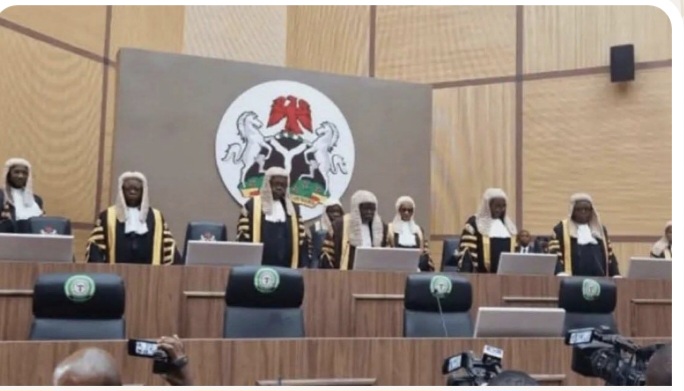
Nigeria’s political landscape recorded a significant legal shift as the Supreme Court moved to restore the leadership of the African Democratic Congress (ADC) under former Senate President, David Mark, while directing that the substantive issues in the dispute continue at the Federal High Court.
In a decisive ruling, the apex court nullified the earlier “status quo ante bellum” order that had effectively disrupted the operational control of the party. The implication of this decision is that the leadership structure led by Mark regains recognition—at least temporarily—pending the final determination of the matter at the lower court.
The case itself is rooted in a prolonged internal crisis within the ADC, where rival factions have laid competing claims to the party’s national leadership. The dispute intensified following earlier rulings by both the Federal High Court and the Court of Appeal, which had sought to maintain an earlier structure while litigation continued.
At the heart of the legal battle is the argument over whether the judiciary should intervene in what some parties describe as an internal political matter. The Mark-led faction has consistently maintained that party leadership disputes fall outside the jurisdiction of the courts, while opposing groups insist that judicial clarification is necessary to prevent what they describe as an unlawful takeover.
The Supreme Court’s intervention now creates a dual-track outcome: restoring immediate leadership control to one faction while simultaneously reaffirming that the underlying legal questions must still be resolved through due judicial process at the Federal High Court.
This development comes at a critical time, as Nigeria’s political parties reposition ahead of the 2027 general elections. The ADC, in particular, has emerged as a focal point for opposition realignments, attracting high-profile political figures and positioning itself as a potential coalition platform.
However, the crisis has exposed deeper structural tensions within the party. Prior to the Supreme Court ruling, a Federal High Court had restrained the electoral body from recognising certain congresses linked to the disputed leadership and barred key figures from interfering with established party structures. These conflicting judicial interventions highlight the complexity of the case and underscore the fragile nature of internal party governance in Nigeria.
Political observers note that beyond the legal technicalities, the ruling carries broader implications for Nigeria’s democratic process. Leadership disputes within parties often shape candidate selection, coalition strength, and ultimately electoral outcomes. With timelines for party primaries and electoral preparations already underway, delays or uncertainties in leadership structures could have far-reaching consequences.
The Supreme Court’s decision, therefore, may offer temporary clarity but not final resolution. By returning the substantive issues to the High Court, the apex court has effectively signalled that the matter is far from concluded.
In practical terms, this means that while the Mark-led leadership may resume control, the legitimacy of that leadership remains subject to judicial scrutiny. The final outcome will likely determine not just the future of the ADC, but also its role in the evolving political dynamics leading into the next election cycle.
For now, the ruling underscores a recurring theme in Nigeria’s political environment: that internal party democracy, legal interpretation, and power struggles remain deeply intertwined—and often unresolved until the very edge of electoral deadlines.
—————————————————————————————————————————————
Your help to our media platform will support the delivery of the independent journalism and broadcast the world needs. Support us by making any contribution. Your donation and support allows us to be completely focus, deeply investigative and independent. It also affords us the opportunity to produce more programmes online which is a platform universally utilised.
Thank you.
Please click link to make – DONATION