

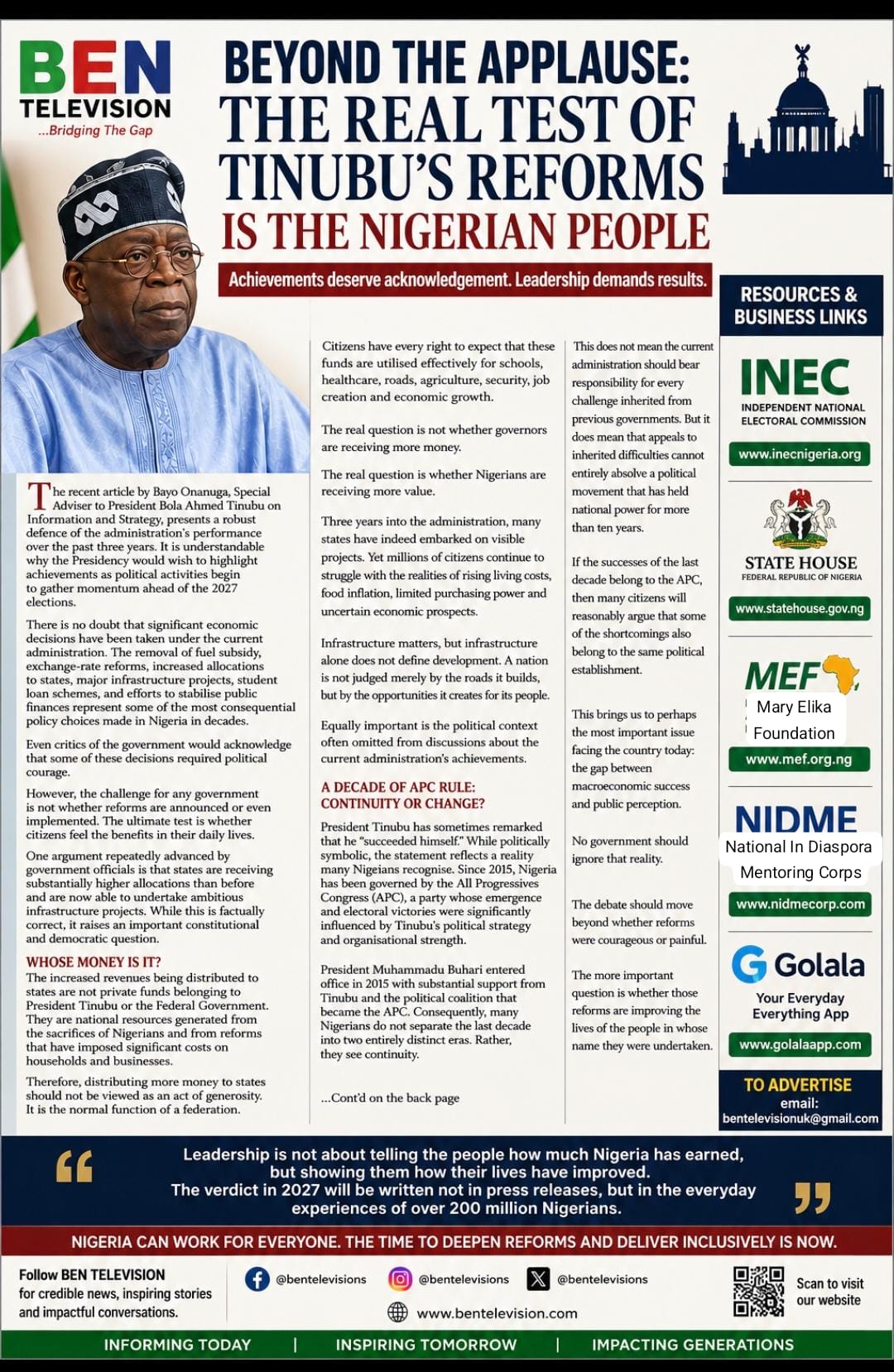
The recent article by Bayo Onanuga, Special Adviser to President Bola Ahmed Tinubu on Information and Strategy, presents a robust defence of the administration’s performance over the past three years. It is understandable why the Presidency would wish to highlight achievements as political activities begin to gather momentum ahead of the 2027 elections.
There is no doubt that significant economic decisions have been taken under the current administration. The removal of fuel subsidy, exchange-rate reforms, increased allocations to states, major infrastructure projects, student loan schemes, and efforts to stabilise public finances represent some of the most consequential policy choices made in Nigeria in decades.
Even critics of the government would acknowledge that some of these decisions required political courage.
However, the challenge for any government is not whether reforms are announced or even implemented. The ultimate test is whether citizens feel the benefits in their daily lives.
One argument repeatedly advanced by government officials is that states are receiving substantially higher allocations than before and are now able to undertake ambitious infrastructure projects. While this is factually correct, it raises an important constitutional and democratic question.
Whose money is it?
The increased revenues being distributed to states are not private funds belonging to President Tinubu or the Federal Government. They are national resources generated from the sacrifices of Nigerians and from reforms that have imposed significant costs on households and businesses.
Therefore, distributing more money to states should not be viewed as an act of generosity. It is the normal function of a federation. Citizens have every right to expect that these funds are utilised effectively for schools, healthcare, roads, agriculture, security, job creation and economic growth.
The real question is not whether governors are receiving more money.
The real question is whether Nigerians are receiving more value.
Three years into the administration, many states have indeed embarked on visible projects. Yet millions of citizens continue to struggle with the realities of rising living costs, food inflation, limited purchasing power and uncertain economic prospects. Infrastructure matters, but infrastructure alone does not define development.
A nation is not judged merely by the roads it builds, but by the opportunities it creates for its people.
Equally important is the political context often omitted from discussions about the current administration’s achievements.
President Tinubu has sometimes remarked that he “succeeded himself.” While politically symbolic, the statement reflects a reality many Nigerians recognise. Since 2015, Nigeria has been governed by the All Progressives Congress (APC), a party whose emergence and electoral victories were significantly influenced by Tinubu’s political strategy and organisational strength.
President Muhammadu Buhari entered office in 2015 with substantial support from Tinubu and the political coalition that became the APC. Consequently, many Nigerians do not separate the last decade into two entirely distinct eras. Rather, they see continuity.
This does not mean the current administration should bear responsibility for every challenge inherited from previous governments. But it does mean that appeals to inherited difficulties cannot entirely absolve a political movement that has held national power for more than ten years.
If the successes of the last decade belong to the APC, then many citizens will reasonably argue that some of the shortcomings also belong to the same political establishment.
This brings us to perhaps the most important issue facing the country today: the gap between macroeconomic success and public perception.
Government officials point to stronger reserves, increased revenues, stock market growth and improved investor confidence. These indicators matter. They signal that certain economic fundamentals may be improving.
Yet ordinary citizens measure economic success differently.
They measure it at the market.
At the fuel station.
At the pharmacy.
At school fee payment counters.
At their farms and places of work.
For many families, economic hardship remains severe. This does not necessarily mean reforms have failed. It does, however, mean that reforms have not yet translated into sufficient relief for a large proportion of the population.
No government should ignore that reality.
Security remains another defining issue. Regardless of economic statistics, insecurity continues to dominate public consciousness. Farmers, traders, transport operators, investors and families all factor security concerns into daily decisions. For many Nigerians, insecurity is not simply one policy challenge among many. It is the challenge that influences every other aspect of life.
Economic growth means little if citizens do not feel safe.
This is where future policy may require a broader approach.
Beyond increasing allocations to states, there is a compelling case for creating stronger partnerships with the private sector, development institutions, cooperatives and internationally recognised non-governmental organisations. More resources should be directed towards entrepreneurship development, small and medium-sized enterprises, agricultural value chains, vocational training, innovation hubs and youth-led enterprises.
Large infrastructure projects are necessary, but thriving economies are built not only by governments constructing roads. They are built when millions of citizens are empowered to create wealth, employ others and contribute productively to society.
The next phase of reform should therefore focus less on government spending and more on citizen empowerment.
History may ultimately judge President Tinubu as a leader who undertook difficult reforms that previous administrations avoided. That possibility remains very much alive.
However, history is rarely written by economic indicators alone.
It is written by the lived experiences of ordinary people.
As the nation approaches another electoral cycle, both government and opposition would benefit from recognising a simple truth: Nigerians are less interested in political victories than in practical outcomes. They want security. They want jobs. They want functioning institutions. They want accountability. They want a future in which hard work produces dignity and opportunity.
The debate should therefore move beyond whether reforms were courageous or painful.
The more important question is whether those reforms are improving the lives of the people in whose name they were undertaken.
That, ultimately, is the standard by which every government must be judged.
—————————————————————————————————————————————
Your help to our media platform will support the delivery of the independent journalism and broadcast the world needs. Support us by making any contribution. Your donation and support allows us to be completely focus, deeply investigative and independent. It also affords us the opportunity to produce more programmes online which is a platform universally utilised.
Thank you.
Please click link to make – DONATION