

TINUBU–FBI FILES: THE 1993 FORFEITURE, THE SECRET FILES AND THE QUESTION OF WHAT HAPPENED BEHIND THE SCENES
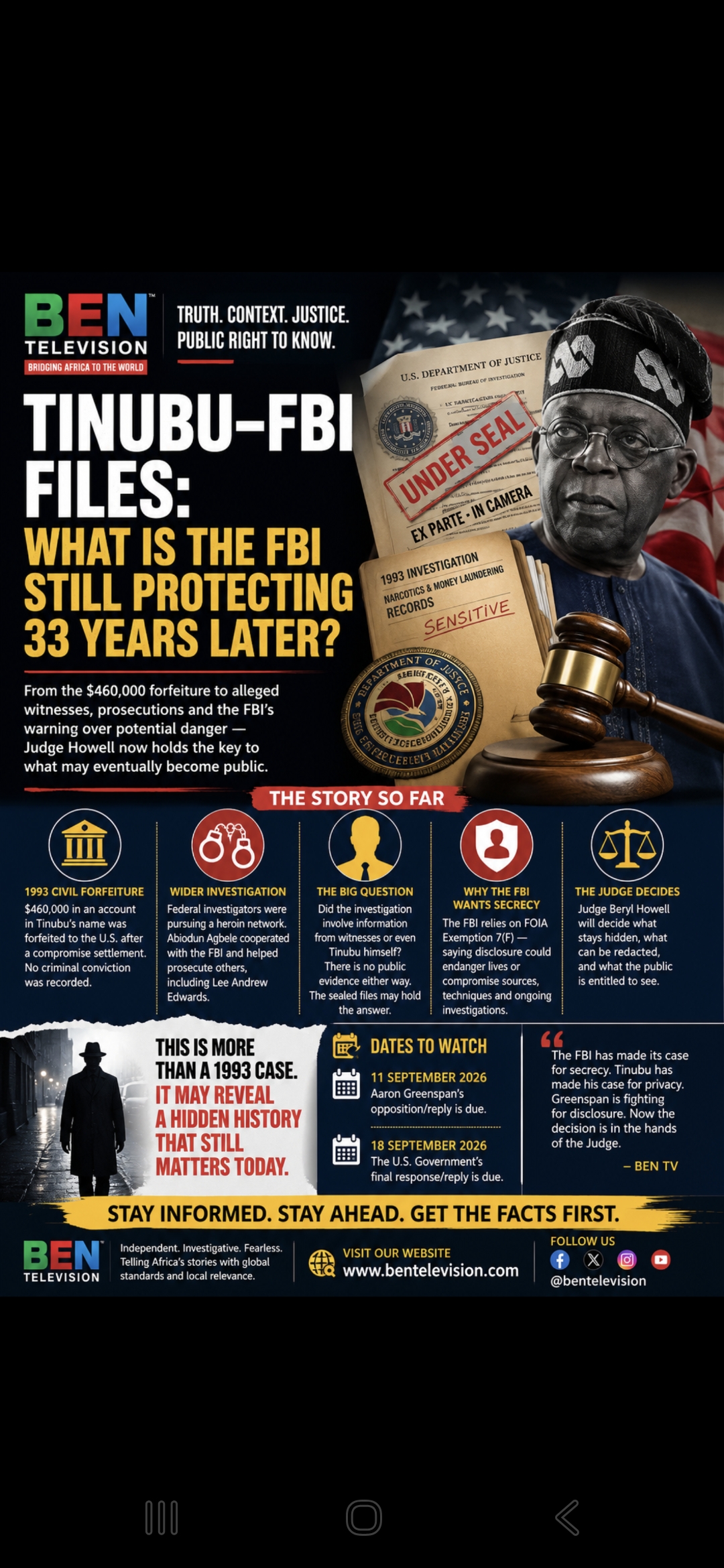
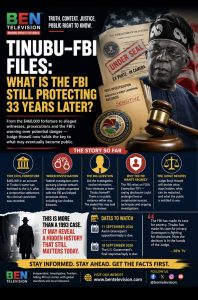
From the $460,000 forfeiture to alleged witnesses, prosecutions and the FBI’s warning over potential danger — Judge Howell now holds the key to what may eventually become public.
he latest development in the long-running battle over FBI and DEA records concerning President Bola Ahmed Tinubu has moved the controversy into a more intriguing phase. On 28 August 2026, the FBI handed confidential material to US District Judge Beryl Howell for private examination. The records were submitted under seal, ex parte and in camera — meaning the judge, rather than the public or the party seeking disclosure, can now see the FBI’s detailed justification for withholding them.
This does not mean the files have been released, nor does it establish that Tinubu committed a criminal offence. That distinction is crucial. The underlying 1993 matter was a civil forfeiture proceeding, not a criminal conviction. US court records show that $460,000 in an account in Tinubu’s name was forfeited to the United States after a compromise settlement. The forfeiture decree stated that the money represented proceeds of narcotics trafficking or was involved in transactions violating US money-laundering laws. Tinubu was never criminally convicted in that case.
 But the newly revived FBI dispute raises a different historical question: what did investigators learn that never became part of the public record?
The publicly available court material already establishes that federal investigators were examining a Chicago-area heroin network and that Abiodun Agbele, identified in the investigation as a supplier, cooperated with authorities after his arrest. A later US appellate court record confirms that Agbele cooperated with the government in the prosecution of Lee Andrew Edwards.
That opens an intriguing — but presently unproven — possibility. Could the wider investigation have involved information supplied by people who helped federal prosecutors pursue other members of the network? Could Tinubu himself have provided information at some stage? There is currently no public evidence establishing that he became an FBI informant or prosecuting witness, and responsible reporting should not present that as fact.
Nevertheless, the question becomes more interesting when placed against the FBI’s latest position. The Bureau is relying, among other provisions, on FOIA Exemption 7(F), which protects information where disclosure could reasonably be expected to endanger someone’s life or physical safety. It has told the court that it cannot fully explain its reasoning publicly and therefore needs to make its case privately to Judge Howell.
If the sealed material ultimately reveals that historic sources, agents, witnesses or investigative relationships remain sensitive, it could help explain why records dating back more than 30 years have not simply been opened.
There is another important possibility: the files may eventually be released in part, years later, after the people or circumstances they protect are no longer considered vulnerable. A future administration, court order, FOIA challenge or change in circumstances could therefore expose material that remains protected today.
And that is where the 1993 forfeiture becomes significant. Tinubu reached a settlement and forfeited $460,000, while the broader investigation continued against others. Whether he merely resolved a civil property dispute, supplied information, assisted investigators, or had some other relationship with US authorities remains unknown from the public record.
Judge Howell now has the opportunity to examine what the FBI says lies behind the secrecy.
The next question is therefore no longer simply “What is in the Tinubu files?”
It is: “Why, after more than three decades, does the FBI still believe releasing parts of them could endanger people?”
That answer may ultimately tell us far more about the hidden history of the 1990s investigation than the $460,000 forfeiture itself.
—————————————————————————————————————————————
Your help to our media platform will support the delivery of the independent journalism and broadcast the world needs. Support us by making any contribution. Your donation and support allows us to be completely focus, deeply investigative and independent. It also affords us the opportunity to produce more programmes online which is a platform universally utilised.
Thank you.
Please click link to make – DONATION