


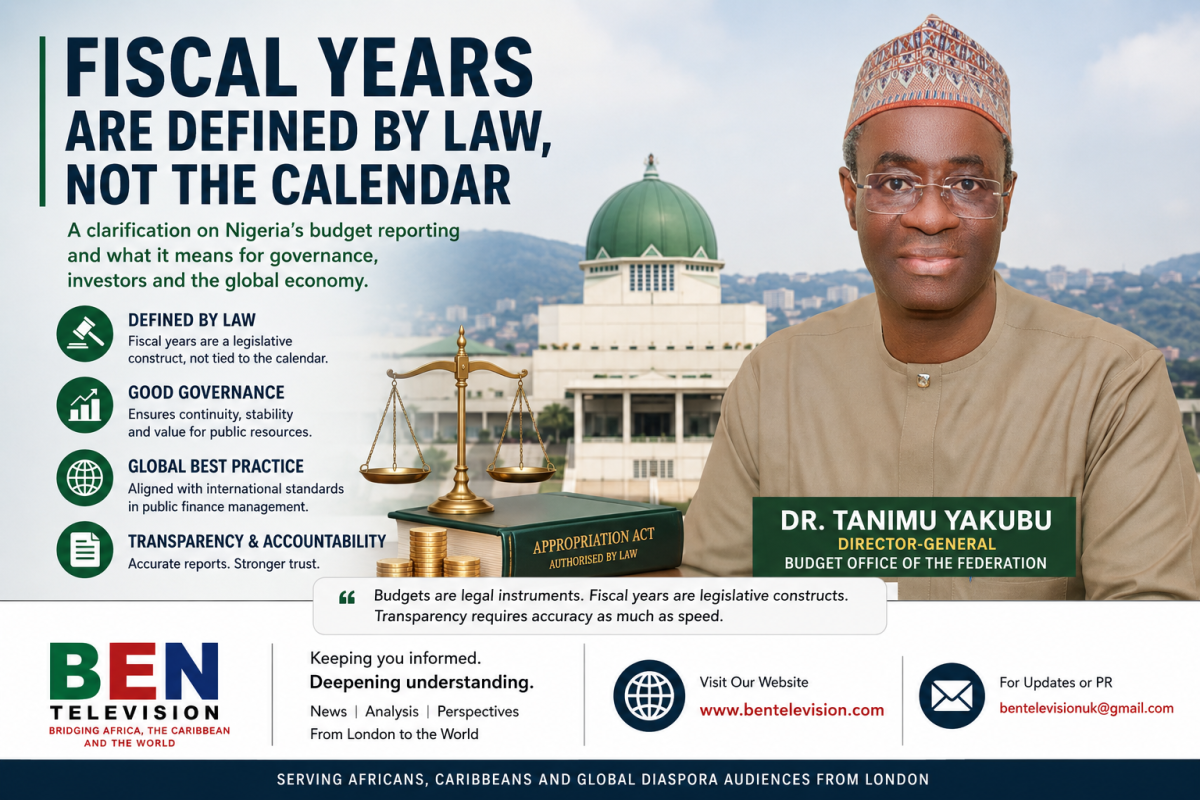
In an era when governments across the world are under increasing pressure to demonstrate fiscal discipline, transparency and accountability, Dr. Tanimu Yakubu’s recent statement on the publication timeline of Nigeria’s Quarterly Budget Implementation Reports provides an important and timely contribution to public finance discourse.
 His central message is both simple and profound: a fiscal year is defined by law, not by the calendar.
While this may appear to be a technical distinction, it is in fact a foundational principle of constitutional governance, budget implementation and macroeconomic management. It is a clarification with implications not only for Nigeria, but also for policymakers, economists, investors and development partners around the world.
A calendar year always runs from January to December. A fiscal year, however, is the legal and administrative period during which a government is authorised by parliament to raise and spend public funds. The calendar is determined by chronology; the fiscal year is determined by legislation.
This distinction explains why many countries do not align their fiscal years with the standard calendar. The United States operates its federal fiscal year from October 1 to September 30. India runs its fiscal year from April 1 to March 31. The United Kingdom’s government financial year also runs from April 1 to March 31. These models reflect national economic realities and legislative choices rather than fixed dates on a calendar.
Nigeria’s constitutional framework fully supports this principle. Sections 80 and 81 of the Constitution of the Federal Republic of Nigeria, 1999 (as amended), require that all withdrawals from the Consolidated Revenue Fund be authorised by the National Assembly. The Constitution does not mandate that expenditure authority must expire strictly on December 31. Therefore, when the National Assembly lawfully extends budget implementation through supplementary legislation, re-enactment or appropriation extensions, such authority remains constitutionally valid until its legal expiration.
The current public discussion arose because of concerns over delays in publishing some Quarterly Budget Implementation Reports. Dr. Yakubu explained that this resulted from the repeal and re-enactment of the 2025 Appropriation Act in December 2025, together with the extension of budget implementation through June 2026. These legislative adjustments extended the operational lifespan of the 2025 Budget beyond the conventional twelve-month cycle.
Following these changes, the Budget Office undertook comprehensive reconciliations covering revenue performance, cash management, expenditure alignment, debt and financing updates, and inter-agency coordination to ensure that the reports are accurate, complete and audit-ready.
This approach is consistent with global best practice. During and after the COVID-19 pandemic, many governments around the world extended budget implementation windows to address procurement delays, revenue shocks, project continuity and employment protection. These measures were not constitutional anomalies; they were prudent fiscal responses to extraordinary economic circumstances.
Dr. Yakubu’s argument is also supported by established legal precedent. In Attorney-General of Bendel State v. Attorney-General of the Federation, the Nigerian Supreme Court affirmed the constitutional centrality of legislative control over public revenues and expenditures. Similarly, in Attorney-General v. De Keyser’s Royal Hotel Ltd, a landmark United Kingdom case, the courts held that executive powers are subordinate to statutory authority where Parliament has legislated comprehensively.
For investors, development partners and international financial institutions, this clarification is particularly significant. Confidence in a nation’s fiscal management depends on legal certainty, institutional discipline and reliable reporting. When governments explain clearly how and why budget cycles are extended, they reinforce trust and demonstrate adherence to constitutional norms.
This is especially important in today’s global environment, where many economies face elevated debt-servicing costs, inflationary pressures, exchange-rate volatility and geopolitical uncertainty. Countries that maintain robust legal and institutional frameworks for managing public finances are better positioned to attract investment and maintain macroeconomic stability.
Nigeria’s efforts to strengthen its fiscal reporting architecture therefore deserve attention. Dr. Yakubu announced that the Budget Office is enhancing its digital systems, data harmonisation processes and inter-agency coordination mechanisms to support more timely, comprehensive and analytically robust reporting in line with evolving international public finance standards.
This reform agenda reflects Nigeria’s commitment to open budgeting, fiscal discipline, transparency and accountable public financial management. It also demonstrates that Africa’s largest economy is continuing to modernise its financial governance institutions.
Dr. Tanimu Yakubu’s statement is more than an explanation of a reporting timetable. It is a thoughtful exposition of constitutional economics and public finance law. It reminds citizens and stakeholders that budgets are legal instruments, fiscal years are legislative constructs, and transparency requires accuracy as much as speed.
At a time when confidence in public institutions is under scrutiny across the world, his intervention stands as a timely and authoritative reaffirmation that effective fiscal governance rests not merely on numbers, but on the rule of law.
For Nigeria, this is a clear demonstration of institutional maturity and constitutional order. For the global fiscal community, it is a valuable reminder that sound public finance management depends on legislative authority, rigorous reporting and unwavering commitment to accountability.
Dr. Tanimu Yakubu is the Director-General of the Budget Office of the Federation, Nigeria. His recent clarification on fiscal-year interpretation offers an important contribution to constitutional and public finance scholarship and is worthy of broad readership among policymakers, economists, legal scholars and international development practitioners.
MCA
—————————————————————————————————————————————
Your help to our media platform will support the delivery of the independent journalism and broadcast the world needs. Support us by making any contribution. Your donation and support allows us to be completely focus, deeply investigative and independent. It also affords us the opportunity to produce more programmes online which is a platform universally utilised.
Thank you.
Please click link to make – DONATION