

Nigeria’s political and security environment has come under renewed scrutiny following a strongly worded “State of the Nation” statement issued by a group of respected elder statesmen, diplomats, academics, former public officials, and civil society leaders.
The intervention comes at a particularly sensitive moment. Since the statement was issued, the nation has continued to grapple with serious security concerns, including the reported death in captivity of a retired Nigerian Army General in Katsina State, a development that has further heightened public anxiety about insecurity and the effectiveness of current security responses.
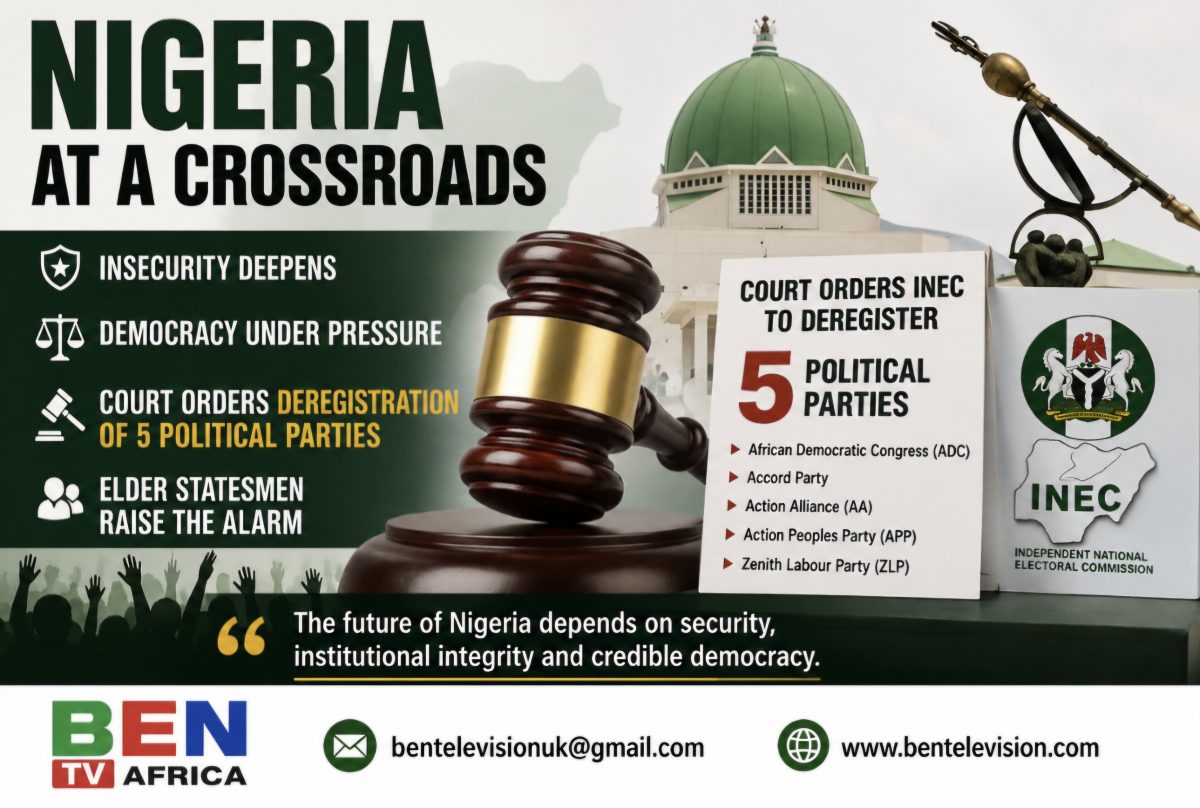
Adding to the political tension, a Federal High Court in Abuja recently ordered the Independent National Electoral Commission (INEC) to deregister five political parties — the African Democratic Congress (ADC), Accord Party (AP), Action Alliance (AA), Action Peoples Party (APP), and Zenith Labour Party (ZLP) — over constitutional electoral performance requirements. The ruling has generated widespread debate because some of the affected parties are associated with prominent opposition politicians ahead of the 2027 elections. Appeals against the judgement are already underway.
While supporters of the ruling argue that it merely enforces existing constitutional provisions, critics view the development as potentially narrowing the democratic space at a time when political competition should be expanding.
The signatories to the State of the Nation statement warned that Nigeria faces a convergence of insecurity, weakening institutions, declining public trust, and challenges to democratic accountability. They also highlighted growing instability across the Sahel region, arguing that events in Mali, Burkina Faso and Niger continue to have direct implications for Nigeria’s security architecture.
Across mature democracies, interventions by elder statesmen often serve as an early warning mechanism rather than a partisan attack. In the United Kingdom, former Prime Ministers and senior public figures routinely challenge serving governments on national policy. In the United States, retired military leaders, former presidents, governors, and bipartisan commissions regularly contribute to debates on national security and governance.
Strong democracies are often distinguished not by the absence of criticism but by their willingness to engage with criticism constructively.
The Nigerian intervention therefore presents an important test: whether the concerns raised by respected national figures will trigger broader reflection, policy reassessment, and institutional reform, or simply become another episode in the country’s increasingly polarised political discourse.
The signatories called for stronger democratic institutions, greater judicial independence, credible elections, enhanced regional security cooperation, and greater accountability across all arms of government.
As Nigeria approaches another electoral cycle, many observers argue that public confidence will depend not only on economic performance and security outcomes but also on the perceived fairness, inclusiveness, and credibility of democratic processes.
Ultimately, the message from the signatories is clear: the future stability of Nigeria depends on preserving both national security and democratic integrity. History suggests that nations thrive when governments are prepared to listen to respected voices, even when those voices deliver uncomfortable truths.
The court’s decision ordering INEC to deregister the African Democratic Congress (ADC), Accord Party (AP), Action Alliance (AA), Action Peoples Party (APP), and Zenith Labour Party (ZLP) is now part of the broader national debate about democratic competition ahead of the 2027 elections. The ADC in particular has attracted prominent opposition figures, making the ruling politically consequential. The affected parties and INEC have indicated plans to challenge the decision through the appellate process.
Signatories are –
Dr. Husseini Abdu — Civil society leader and public policy advocate.
Amb. Fatima Balla — Former ambassador and governance advocate.
Dr. Usman Bugaje — Former lawmaker and northern intellectual voice.
Amb. Ibrahim Gambari — Former Chief of Staff and distinguished international diplomat.
Yahaya Hashim — Entrepreneur and governance advocate.
Jibrin Ibrahim — Democracy, elections and governance scholar.
Prof. Attahiru Jega — Led Nigeria’s electoral commission during major reforms.
Mohammed Kuna — Researcher on governance and national development.
Abubakar Balarabe Mahmoud — Former Nigerian Bar Association President.
Kabiru Yusuf — Founder of a leading Nigerian media platform etc.
—————————————————————————————————————————————
Your help to our media platform will support the delivery of the independent journalism and broadcast the world needs. Support us by making any contribution. Your donation and support allows us to be completely focus, deeply investigative and independent. It also affords us the opportunity to produce more programmes online which is a platform universally utilised.
Thank you.
Please click link to make – DONATION