

The recent incident involving a U.S.-registered Bombardier Challenger 601 executive jet, registration N989BC, which reportedly landed on a roadway near Ogwashi-Uku in Delta State before subsequently departing the location, has raised serious aviation safety, regulatory, and national security concerns.
While social media has focused on sensational claims and presented various views on landing and take-off on the major expressway for the runway at Asaba International Airport, aviation professionals understand that such conclusions should not be drawn before a full investigation is completed.
What is beyond dispute is that an unusual and potentially dangerous event occurred, prompting the Nigeria Civil Aviation Authority (NCAA) to ground the aircraft and suspend the operator’s permit pending investigation.
This matter deserves more than social media speculation. It requires a transparent, independent, and professional investigation.
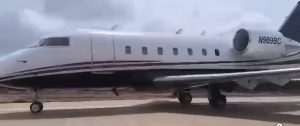 The aircraft involved, registration N989BC, is a Bombardier Challenger 601-3A/ER executive jet, serial number 5021, manufactured in 1988.
The aircraft is approximately 38 years old and is powered by two General Electric CF34 turbofan engines. It is capable of carrying up to 22 occupants and flying thousands of kilometres non-stop, making it suitable for international executive travel.
Public aviation records indicate the aircraft is registered in the United States and linked to Best Aircraft Deals LLC of Salt Lake City, Utah. The aircraft has previously been advertised for executive and charter operations and remains active within international aviation networks.
The Challenger series is widely respected globally and is used by governments, corporations, diplomats, and high-net-worth individuals.
Therefore, the issue is not necessarily the aircraft itself, but rather the circumstances surrounding its operation.
What Happened?
 According to preliminary information released by the NCAA, the aircraft reportedly conducted a missed approach while attempting to land at Asaba Airport before subsequently landing on a roadway in the Ogwashi-Uku area.
All occupants reportedly exited safely.
However, regulators further stated that the aircraft later departed the location and returned to Lagos without obtaining the required regulatory approval.
That development transformed what may initially have been considered an operational occurrence into a matter of regulatory concern.
The NCAA has since grounded the aircraft and commenced investigations.
Questions Aviation Authorities Must Answer
A thorough investigation should establish:
- What caused the aircraft to abandon its original approach into Asaba Airport?
- Was the road landing the result of an emergency, technical malfunction, weather conditions, human error, navigational error, or another operational factor?
- Were all required communications made with Air Traffic Control before and after the incident?
- Was the aircraft authorised to depart the roadway location?
- Were all applicable Nigerian aviation regulations followed?
- What was the aircraft’s actual origin and intended destination?
- Who were the passengers and what was the purpose of the flight?
- Was the aircraft operating under a charter arrangement, private business mission, diplomatic movement, or another category of operation?

Minister of Aviation
What Would Happen in Advanced Aviation Nations?
In countries such as the United Kingdom, United States, Canada, France, Germany, Australia, or Singapore, an aircraft landing outside an approved aerodrome environment would immediately trigger multiple investigations.
Authorities would typically secure the aircraft, restrict its movement, collect cockpit voice recordings, recover flight data, inspect the aircraft, interview crew members, and review all communications with air traffic controllers.
The aircraft would ordinarily remain available to investigators until released by the appropriate authority.
Any unauthorised movement before completion of these procedures would attract intense scrutiny.
The objective would not be punishment alone, but learning lessons to prevent future occurrences.
Nigeria deserves no lower standard.
National Security Concerns
The incident also highlights wider concerns repeatedly expressed by citizens regarding aircraft movements into sensitive and remote locations.

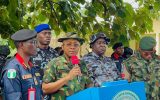
Minister of Defence – Gen Christopher Musa Rtd.
Nigeria continues to face security challenges including terrorism, kidnapping, illegal arms trafficking, organised crime, and transnational criminal networks.
For this reason, the public expects aviation regulators, security agencies, airport authorities, customs, immigration, intelligence agencies, and law enforcement institutions to maintain strong oversight of private aviation operations.
Questions naturally arise whenever aircraft movements appear unusual or insufficiently explained.
Authorities must therefore reassure citizens that:
- All private flights are properly documented.
- Passenger manifests are verified.
- Cargo declarations are accurate.
- Flight plans are properly filed.
- Security screening procedures are followed.
- No unlawful activities are being facilitated through private aviation channels.
Transparency helps build public confidence.
A Moment for Reform
This incident should become an opportunity to strengthen aviation governance rather than merely generate headlines.
Nigeria’s aviation industry has made significant progress over the years, but events such as this remind us that continuous vigilance is essential.
The investigation should be comprehensive, independent, and transparent.
Its findings should be made public.
Where deficiencies are identified, corrective actions should follow.
Where regulations have been violated, appropriate sanctions should apply.
Where safety lessons can be learned, they should be shared across the aviation sector.
Conclusion
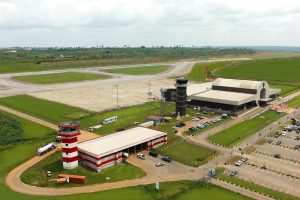
Asaba Intl Airport
The Asaba road-landing incident is more than a viral aviation story.
It is a test of regulatory credibility, aviation safety oversight, and public confidence.
Nigerians deserve clear answers.
The aviation community deserves factual findings.
And the nation deserves assurance that every aircraft operating within its airspace does so safely, legally, and in the interest of national security.
The final report must answer not only how the aircraft came to land on a roadway, but also whether existing systems are sufficient to prevent similar occurrences in the future.
Only a transparent investigation can provide those answers.
—————————————————————————————————————————————
Your help to our media platform will support the delivery of the independent journalism and broadcast the world needs. Support us by making any contribution. Your donation and support allows us to be completely focus, deeply investigative and independent. It also affords us the opportunity to produce more programmes online which is a platform universally utilised.
Thank you.
Please click link to make – DONATION