

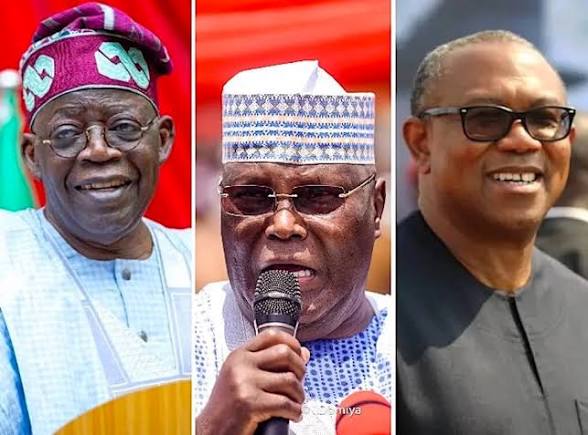
As campaigns for the 2027 general election get underway, leading presidential candidates have unveiled competing visions for Nigeria, offering sharply different approaches to the economy, security, education, healthcare, governance and the country’s political structure.
President Bola Tinubu of the All Progressives Congress (APC), former Vice President Atiku Abubakar of the African Democratic Congress (ADC) and Peter Obi of the Nigeria Democratic Congress (NDC) are anchoring their campaigns on distinct economic and governance programmes, while candidates of smaller parties, including Omoyele Sowore, Donald Duke and Adewole Adebayo, are also presenting alternative policy choices.
The emerging contest is increasingly being defined by competing arguments over whether Nigeria should consolidate the Tinubu administration’s reforms, adopt a production-driven alternative or pursue deeper political and economic restructuring.
Tinubu: Consolidate reforms, target $1trn economy
President Tinubu is campaigning on the Renewed Hope Agenda and the Renewed Hope National Development Plan for 2026 to 2030.
The President has positioned the reforms of his first term, particularly petrol subsidy removal, exchange-rate reforms and measures aimed at increasing government revenue, as the foundation of his second-term bid.
The administration has maintained that the reforms, though painful in the short term, are necessary to correct longstanding economic distortions and place Nigeria on a more sustainable growth path.
Government officials have described 2026 as a turning-point year, with emphasis shifting from economic stabilisation to accelerated growth. This is reflected in the 2026 national budget of about N58.18 trillion.
The administration has also set a target of building a $1 trillion economy by 2030 through manufacturing, infrastructure development and diversification away from dependence on crude oil.
Projects including the Kano-Maradi railway have been cited by the government as evidence of its infrastructure drive.
On security, Tinubu has pointed to institutional reforms and operational gains recorded since 2023 while pledging to deepen them.
The President has acknowledged the hardship caused by the reforms, describing it as the cost of repairing long-standing weaknesses in the economy.
APC National Chairman, Prof. Nentawe Goshwe Yilwatda, said the ruling party would base its campaign on its record and delivery of reforms promised to Nigerians.
The President’s Special Adviser, Tooki Abimbola, said the APC would campaign on results rather than rhetoric.
“The APC will campaign on results, not rhetoric. The next phase is about moving from reform to delivery, from macroeconomic stabilisation to household-level impact, and from security operations to sustainable security,” he said.
He said the party would focus on expanding productive sectors, supporting MSMEs, attracting investment and creating opportunities for young Nigerians.
On the cost of living, Abimbola said the administration recognised that macroeconomic stability would mean little if households continued to struggle with food, transportation and other basic necessities.
He said the government would therefore support increased food production, improved supply chains, reduced logistics costs and targeted interventions for vulnerable households.
However, some government claims about the reach of its interventions have faced scrutiny, with independent reviews of programmes, including a presidential loan and grant scheme said to have reached more than 900,000 small businesses, questioning the figures against available disbursement records.
Atiku: Production, restructuring, security
Atiku, who emerged as the ADC presidential candidate from its 2026 primaries, is campaigning on a programme drawn from his acceptance speech, the party’s policy positions and the Atiku Economic Recovery Plan (AERP) 2027 launched in August 2026.
His agenda places security, education, the economy, healthcare and restructuring among its major priorities.
On security, Atiku has promised to expand the armed forces and police, provide modern equipment, improve training and welfare, and strengthen coordination among security agencies.
His education proposal includes free and compulsory primary and secondary education, alongside greater emphasis on leadership, entrepreneurship, technology and innovation.
In healthcare, he has pledged increased funding for primary healthcare centres and specialist hospitals while encouraging private investment in medical facilities to reduce the number of Nigerians travelling abroad for treatment.
A major component of the AERP is a proposed production subsidy under which qualifying public and private refineries would have access to domestic crude at preferential prices, subject to conditions on output, efficiency, transparency and domestic supply.
The plan also proposes a fixed annual spending ceiling in the federal budget, independent audits and mechanisms to ensure that the benefits of such interventions reach consumers.
Atiku has further called for a public reconciliation of an estimated N30 trillion in Federation Account entries linked to energy and past subsidy claims.
The ADC platform also emphasises a production-driven economy, a living wage, an independent electoral body, zero-impunity governance and performance audits of public spending.
Food security is proposed as a national security priority, while restructuring and greater devolution of powers remain central to the party’s political message.
Obi: From consumption to production
Peter Obi is campaigning on the message that “Nigeria can work, and Nigeria must work,” with the central plank of his economic programme being a shift from consumption to production.
His proposals include securing farming communities, expanding irrigation, improving rural roads and storage facilities, and connecting farmers to finance and markets.
He has also promised to strengthen manufacturing and agro-processing to increase production and exports of finished goods.
On public finance, Obi has pledged to reduce wasteful government spending and ensure that public expenditure is tied to clear outcomes while increasing revenue without undermining private businesses.
His security plan includes improved intelligence gathering, better coordination among security agencies, technology-supported policing and stronger border management.
He has also advocated support for lawful community-based early-warning systems and greater decentralisation of security management while maintaining federal-state coordination.
Obi has proposed reforms across basic education, universities and technical and vocational training.
In healthcare, he has focused on strengthening primary healthcare, improving access to essential medicines and equipment, and tackling high maternal and infant mortality.
He has also released a region-by-region development plan covering the six geopolitical zones and the Federal Capital Territory.
National Publicity Secretary of the NDC, Osa Director, said the party intended to distinguish itself through openness and sincerity in addressing the country’s problems.
“Our primary priority is to move Nigeria from a consumption economy to a production economy,” he said.
According to him, the party intends to revive moribund industries, create a business-friendly environment, stabilise the naira and address insecurity as prerequisites for attracting both foreign and domestic investment.
He argued that increased production and employment would help bring down inflation and reduce poverty.
Sowore: Revolutionary change
Omoyele Sowore of the African Action Congress (AAC) is campaigning on what he describes as revolutionary change.
Among his proposals are the use of artificial intelligence in the management of public finances and drone technology for defence and security operations.
Sowore has also proposed free education at all levels and the abolition of WAEC and NECO examination fees.
Duke: Education, healthcare, security
Donald Duke, presidential candidate of the Peoples Redemption Party (PRP), is focusing his campaign on education, healthcare, infrastructure, security and reform of the justice system.
Duke has also called on opposition political parties to form a coalition against the APC.
On the economy, the former Cross River State governor has called for a fundamental shift from the current policy direction, arguing that Nigeria must turn its natural and human resources into productive assets and make citizens’ welfare the central measure of economic performance.
He has particularly criticised the handling of fuel subsidy and argued that economic performance should be assessed through employment, income per capita and improvements in living standards rather than government revenue or foreign reserves alone.
Adebayo: Power, productivity, institutions
Adewole Adebayo of the Social Democratic Party (SDP) has presented a five-point agenda focused on insecurity, unemployment, low productivity, inadequate power supply and weak institutions.
He has set a target of 75,000 megawatts of electricity and warned against what he described as a drift towards one-man rule.
With the 2027 polls approaching, the competing programmes are expected to form the basis of increasingly intense campaigns as the candidates seek to persuade voters that their respective approaches offer the most credible path out of Nigeria’s economic, security and governance challenges.
—————————————————————————————————————————————
Your help to our media platform will support the delivery of the independent journalism and broadcast the world needs. Support us by making any contribution. Your donation and support allows us to be completely focus, deeply investigative and independent. It also affords us the opportunity to produce more programmes online which is a platform universally utilised.
Thank you.
Please click link to make – DONATION