

Across the world’s major economies, investment decisions are influenced by security, governance, infrastructure, regulatory policies and political stability. From Africa to Europe, Asia and the Americas, governments face different challenges in attracting and retaining foreign capital.
Nigeria is no exception. However, understanding the difference between an official investment assessment, political commentary and a presidential declaration is essential to responsible international reporting.
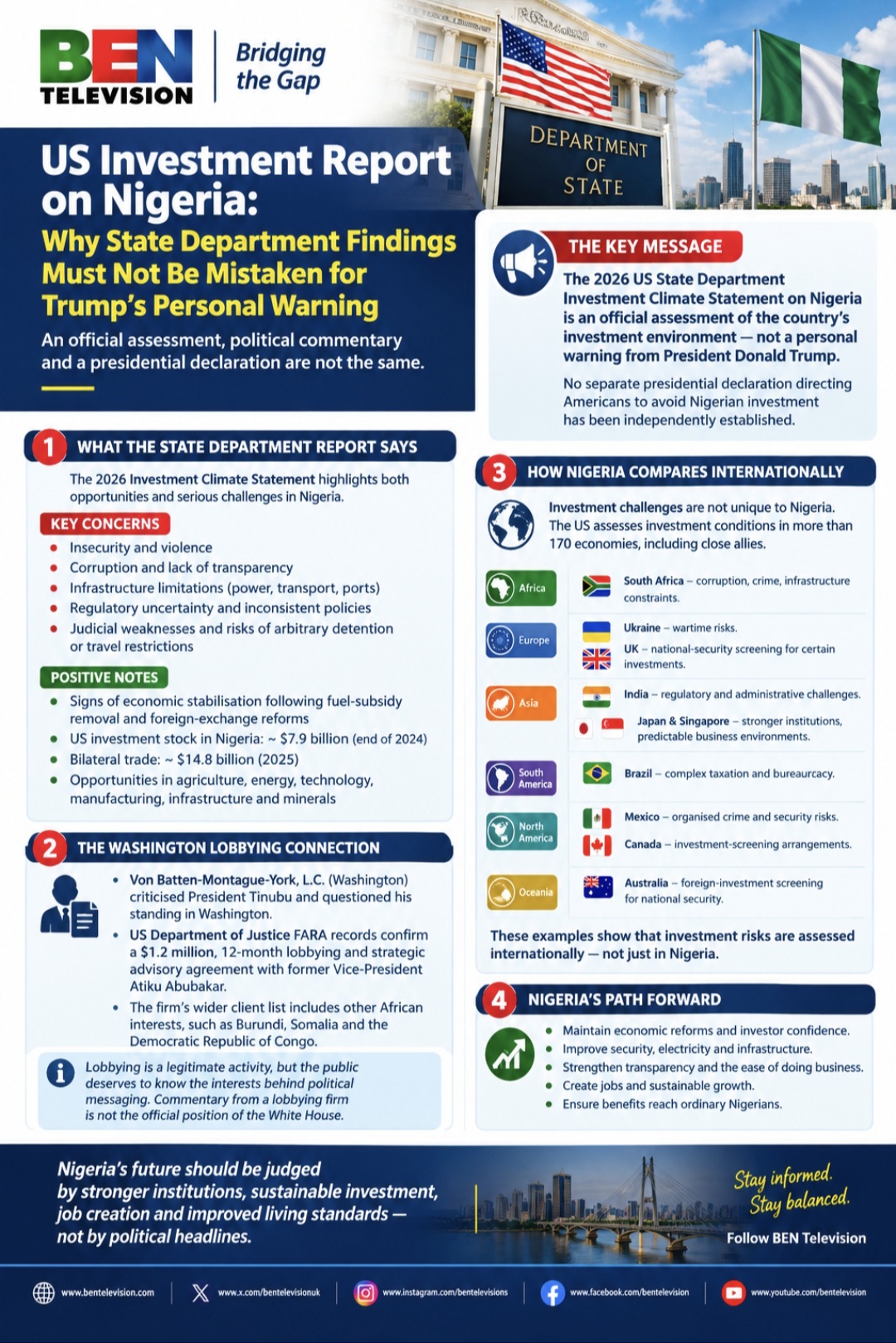
Renewed debate surrounding the United States Department of State’s 2026 Investment Climate Statement on Nigeria followed publicity by Washington-based lobbying firm Von Batten-Montague-York, L.C., and a subsequent media headline suggesting President Donald Trump had personally warned Americans against investing in Nigeria.
The distinction is significant.
The State Department assessment examines Nigeria’s investment environment, including corruption, insecurity, infrastructure limitations and regulatory difficulties. These are legitimate concerns requiring government attention.
However, the publication of a State Department report during President Trump’s administration does not establish that Trump personally issued its conclusions as a warning against Nigeria. No separate presidential declaration directing Americans to avoid Nigerian investment has been independently established.
Political lobbying and the Washington connection
Von Batten-Montague-York publicly criticised President Bola Ahmed Tinubu, questioning his standing in Washington and advancing allegations concerning his administration and personal history.
US Department of Justice Foreign Agents Registration Act records confirm that the firm entered a $1.2 million, 12-month lobbying and strategic advisory agreement with former Vice-President Atiku Abubakar, a political opponent of Tinubu.
The agreement includes government engagement, reputation management and efforts to counter Nigerian government narratives in Washington.
The firm’s broader lobbying history also includes engagements involving African interests beyond Nigeria.
Such activities are lawful and form part of democratic political advocacy. Nevertheless, the public deserves to understand the interests behind political messaging. Lobbying commentary should not automatically be presented as the official position of the White House.
How Nigeria compares internationally
American investment assessments cover countries across the world.
South Africa faces documented concerns over violent crime, corruption and infrastructure constraints. Ukraine confronts extraordinary wartime investment risks, while the United Kingdom applies national-security screening to certain foreign investments.
India faces regulatory and administrative challenges, while Japan and Singapore demonstrate the advantages of stronger institutional environments.
Brazil experiences taxation and bureaucratic complexity. Mexico confronts organised crime and security risks, while Canada and Australia maintain investment-screening systems protecting national interests.
These examples do not suggest identical problems or equivalent levels of risk. They demonstrate that investment conditions are assessed internationally, including among America’s closest allies.
Beyond criticism: Nigeria’s economic future
Nigeria continues to offer opportunities in agriculture, energy, technology, manufacturing, infrastructure and mineral development.
The United States has maintained substantial trade and investment relationships with Nigeria despite longstanding concerns about its business environment.
Economic reforms, including foreign-exchange liberalisation and fuel-subsidy changes, have sought to improve fiscal and market conditions, although their consequences for households and businesses remain significant.
President Tinubu’s administration and state governments must demonstrate measurable progress in security, electricity, transparency, infrastructure and investor protection.
Opposition scrutiny remains essential to democratic accountability. Equally, criticism should be supported by evidence and clearly distinguished from political advocacy.
Nigeria’s economic challenges must neither be concealed nor exaggerated. A State Department investment assessment is not automatically a personal warning from President Trump, and political interpretations should not replace the original document.
Ultimately, Nigeria’s progress must be judged by stronger institutions, sustainable investment, job creation, improved living standards and development that benefits its citizens.
BEN Television — Bridging the Gap – International Affairs Desk
Editorial sources:
[US State Department, 2026 Nigeria Investment Climate Statement](https://www.state.gov/reports/2026-investment-climate-statements/nigeria);
[US Department of Justice, lobbying agreement](https://efile.fara.gov/docs/7130-Exhibit-AB-20260401-3.pdf);
[TheCable, Atiku’s $1.2 million lobbying agreement](https://www.thecable.ng/atiku-hires-us-firm-for-1-2m-to-strengthen-his-reputation-counter-fg-lobbying/);
[US Investment Climate Statements, international comparisons](https://2021-2025.state.gov/reports/2024-investment-climate-statements/).
—————————————————————————————————————————————
Your help to our media platform will support the delivery of the independent journalism and broadcast the world needs. Support us by making any contribution. Your donation and support allows us to be completely focus, deeply investigative and independent. It also affords us the opportunity to produce more programmes online which is a platform universally utilised.
Thank you.
Please click link to make – DONATION