


The Minister of Education, Dr. Maruf Tunji Alausa, has reaffirmed President Bola Ahmed Tinubu’s commitment to placing the Nigerian child at the centre of national development, describing investment in education and the empowerment of girls as critical to building a prosperous nation.
Alausa stated this during the national flag-off of the distribution of two million packs of sanitary towels and back-to-school learning materials to girls in public basic education schools across Nigeria’s 36 states and the Federal Capital Territory (FCT).
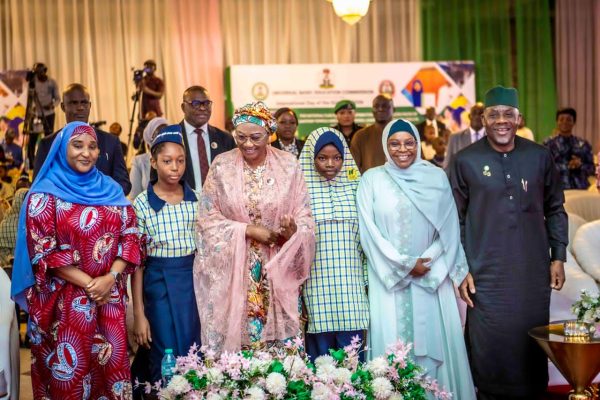
The initiative, tagged “Flow with Confidence 2.0: Keeping Every Girl in School,” was launched by the First Lady, Senator Oluremi Tinubu, at the State House Banquet Hall, Presidential Villa, Abuja, as part of activities marking the 2026 International Day of the Girl Child.
The Minister commended President Tinubu for prioritising the welfare and educational development of Nigerian children under the Renewed Hope Agenda, noting that access to quality education and the necessary support would prepare children to become future leaders, teachers, manufacturers and responsible citizens.
He described girls’ education as an investment in Nigeria’s future, stressing that removing barriers to school attendance and learning would enable girls to develop their abilities, achieve their aspirations and contribute meaningfully to national development.
According to him, the Federal Government remains committed to supporting interventions that expand access to education and ensure that no child is denied the opportunity to learn because of preventable challenges.
In her remarks, the First Lady, Senator Oluremi Tinubu, said the Flow with Confidence 2.0 initiative was designed to protect girls’ dignity, promote menstrual health and hygiene, and encourage their continued participation in education.
She recalled that the Renewed Hope Initiative launched the original Flow with Confidence programme on October 2, 2025, providing a one-year supply of disposable sanitary pads to 370,000 schoolgirls in rural communities across the country.
Tinubu emphasised the need for transparency and accountability in implementing the expanded programme to ensure that the sanitary towels and learning materials reach the intended beneficiaries.
She also called on traditional rulers, religious leaders, parents and community stakeholders to help eliminate the stigma associated with menstruation and create a supportive environment where girls can remain in school, pursue their dreams and realise their full potential.
The First Lady further highlighted the planned scholarship intervention under the Universal Basic Education Commission’s (UBEC) Learners Retention Support Programme, which is expected to benefit 100,000 learners in its first phase.
Under the programme, each beneficiary is expected to receive a grant of ₦20,000 to help address financial challenges affecting school attendance and retention.
Also speaking, the Minister of State for Education, Professor Suwaiba Sa’id Ahmad, described the initiative as an important intervention to protect the dignity of the girl child and promote menstrual health and hygiene.
She stressed that menstruation should not prevent girls from attending school, participating in classroom activities or achieving their educational goals.
Ahmad encouraged girls to remain focused on their studies, work hard and believe in their abilities, noting that their aspirations and future contributions were important to the country’s development.
Similarly, the Executive Secretary of the Universal Basic Education Commission, Dr. Aisha Garba, reaffirmed the Commission’s commitment to improving access to quality basic education and keeping children in school through infrastructure development, the provision of learning materials, teacher training, and improved water and sanitation facilities.
Garba disclosed that UBEC had facilitated the construction of more than 4,000 classrooms nationwide in less than three years.
She added that over three million pupils benefited from back-to-school materials in the preceding year, while collaborative efforts involving relevant agencies and stakeholders had supported the return of approximately 700,000 out-of-school children to the classroom.
The UBEC chief maintained that sustained investment in school infrastructure, learning resources and targeted support programmes remained essential to improving enrolment, attendance and retention, particularly among vulnerable learners.
The Flow with Confidence 2.0 initiative will provide girls in public basic education schools across the 36 states and the FCT with two million packs of sanitary towels, alongside essential learning materials, including school bags, school shoes, exercise books, mathematics textbooks and writing materials.
The intervention is expected to help address challenges associated with menstrual hygiene and inadequate access to educational materials, particularly among girls from disadvantaged backgrounds.
Reaffirming the Federal Government’s commitment, Alausa said the Ministry of Education would continue to support initiatives under the Renewed Hope Agenda aimed at expanding educational opportunities, improving learner retention and strengthening the quality of basic education.
He emphasised that collaboration among government institutions, families, communities and development partners was essential to achieving sustainable improvements in educational outcomes.
The Minister assured that the Federal Government would sustain efforts to ensure that every Nigerian child, particularly girls facing barriers to education, had the opportunity to learn, grow and contribute to the country’s future.
—————————————————————————————————————————————
Your help to our media platform will support the delivery of the independent journalism and broadcast the world needs. Support us by making any contribution. Your donation and support allows us to be completely focus, deeply investigative and independent. It also affords us the opportunity to produce more programmes online which is a platform universally utilised.
Thank you.
Please click link to make – DONATION