


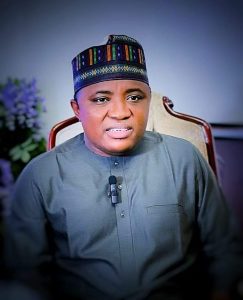
 In Nigerian politics, moments of silence are often more instructive than loud declarations. Yesterday afternoon in Abuja, one such moment unfolded quietly but meaningfully as His Excellency Alhaji Yakubu Murtala Ajaka received key political stakeholders from Igalamela/Odolu Local Government Area at his residence.
The visit, though framed as a courtesy call, was driven by a pressing political question reverberating across Kogi East: Has Ajaka returned to the All Progressives Congress (APC)?
 The stakeholders, a cross-section of loyal party men, grassroots mobilisers and political foot soldiers who stood firmly with him during recent political contests, sought clarity amid widespread rumours of a realignment with the ruling party — a party that once served as his original political home.
In his response, Ajaka dispelled the notion of a purely personal or opportunistic defection. Rather, he explained that his decision to re-engage with the APC was consultative, strategic and guided by senior party leadership. At the centre of this guidance, he revealed, stands his long-time political mentor and benefactor, His Excellency Mai Mala Buni, Governor of Yobe State and Chairman of the APC National Reconciliation Committee.

By invoking Governor Buni’s role, both as a consensus builder and national stabiliser within the APC – Ajaka framed his return not as retreat, but as re-entry into a broader national project focused on unity, reconciliation and development.
This clarification was critical. In a political climate where defections are often viewed with suspicion, Ajaka’s message was deliberate: this is not about abandoning a struggle, but repositioning it.
To understand the weight of this moment, one must revisit the 2023 Kogi governorship election, where Ajaka emerged as one of the most formidable political figures in the state. Contesting against entrenched power structures, he ran a campaign that galvanised youth, bridged ethnic divides across Kogi East, and redefined opposition politics in the state.
Though the election outcome did not favour him, the numbers, reach and momentum of his campaign told a deeper story. Ajaka proved that Kogi politics was no longer the exclusive preserve of incumbency and state machinery. His showing in 2023 elevated him from a regional contender to a statewide political force, commanding loyalty beyond party labels.
For many observers, 2023 was less an end than a political rehearsal, a proof of capacity, structure and acceptability.
 Against this backdrop, Ajaka’s reconnection with the APC is already being interpreted as a calculated move towards 2027. The ruling party remains the most formidable political platform in Nigeria, controlling federal power and a significant number of states. For an aspirant with statewide ambition, operating from the centre of power offers leverage that opposition platforms often struggle to provide.
Yet, Ajaka was careful not to rush the narrative. Instead of grand declarations, he chose reassurance; urging his supporters to remain steadfast, united and patient, while expressing confidence that the journey ahead would deliver “positive and glorious outcomes.”
In Nigerian political language, such words are rarely casual.
Perhaps the most significant outcome of the meeting was not the clarification of party affiliation, but the reaffirmation of loyalty between Ajaka and his base. By engaging directly with stakeholders from his local government, he sent a clear signal: no political decision will be taken without the people who built the movement.
At a time when many politicians ascend only to disconnect from their roots, Ajaka’s insistence on dialogue reinforces his image as a leader whose strength lies in grassroots legitimacy.
As Nigeria gradually turns its gaze towards 2027, political actors are quietly repositioning, building alliances and recalibrating strategies. The Abuja meeting between Alhaji Yakubu Murtala Ajaka and his Igalamela/Odolu stakeholders should be seen in that light; not as a dramatic return, but as a measured step in a longer political journey.
Whether within the APC or beyond it, one reality is increasingly clear: Ajaka remains a central figure in Kogi’s evolving political equation, and the conversations unfolding today are shaping the contests of tomorrow.
—————————————————————————————————————————————
Your help to our media platform will support the delivery of the independent journalism and broadcast the world needs. Support us by making any contribution. Your donation and support allows us to be completely focus, deeply investigative and independent. It also affords us the opportunity to produce more programmes online which is a platform universally utilised.
Thank you.
Please click link to make – DONATION