

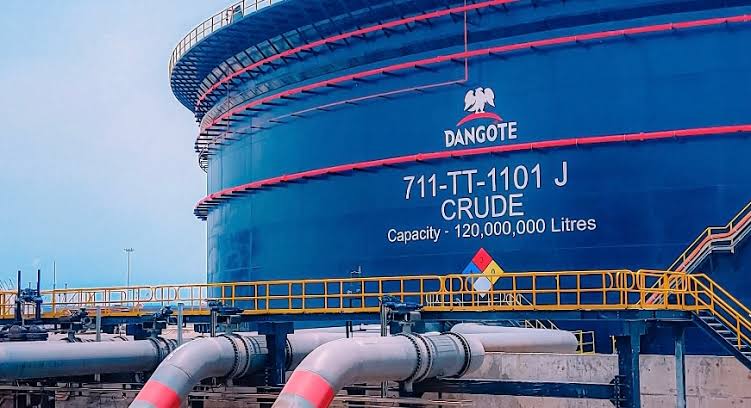
Nigeria’s ambition to end decades of dependence on imported petrol has suffered a significant setback after fuel imports surged sharply in June, despite increasing output from the country’s flagship Dangote Petroleum Refinery.
New industry data shows imports of Premium Motor Spirit (PMS), commonly known as petrol, climbed to an average of 18.1 million litres per day in June, more than tripling from 5.9 million litres per day in May.
The reversal comes less than a year after policymakers and investors hailed the 650,000-barrel-per-day Dangote refinery as a transformative project capable of ending Nigeria’s costly reliance on imported fuel and reducing pressure on the country’s foreign exchange market.
Instead, the latest figures suggest Africa’s biggest oil producer remains caught between expanding domestic refining capacity and a downstream fuel market that continues to rely heavily on overseas supplies.
A Blow to Nigeria’s Energy Independence Narrative
For much of 2024 and early 2025, Nigeria presented the Dangote refinery as a cornerstone of its energy security strategy, arguing that local refining would conserve billions of dollars previously spent importing refined petroleum products.
The project was also expected to strengthen the naira by reducing demand for foreign exchange used to pay international fuel suppliers.
However, data from the Nigerian Midstream and Downstream Petroleum Regulatory Authority (NMDPRA) paints a more complicated picture.
While petrol imports rebounded sharply in June, domestic fuel supply fell by nearly 22 per cent to 32.5 million litres per day, down from 41.5 million litres recorded in May.
Combined domestic production and imports pushed total daily petrol availability to 50.6 million litres, reflecting stronger market demand but also renewed dependence on imported cargoes.
Why Imports Are Rising
Industry participants say supply consistency—not refining capacity alone—remains the biggest challenge.
Fuel marketers report that unpredictable domestic allocations have forced many companies back into the international market, sourcing cargoes from European trading hubs including Rotterdam and Antwerp.
Uncertainty surrounding local petrol pricing has also slowed purchases by independent marketers, with some operators temporarily suspending fuel procurement altogether.
The result is a market that continues to rely on imports even as one of the world’s largest single-train refineries increases production.
The Dangote Puzzle
One of the biggest questions emerging from the latest figures is why imports are rising despite the refinery reporting robust output.
According to the NMDPRA, the Dangote refinery operated at more than 100 per cent of its designed capacity during June, producing an average of 39.1 million litres of petrol daily.
Yet only 32.5 million litres per day were recorded as domestic receipts.
Part of that difference appears to reflect export activity and inventory management.
The refinery exported approximately 3.4 million litres of petrol per day during June while maintaining significant product inventories, suggesting not all production was directed immediately into Nigeria’s domestic market.
For analysts, the discrepancy highlights the complex commercial decisions facing refiners operating in both domestic and export markets.
Foreign Exchange Concerns Return
The resurgence in fuel imports is also reviving concerns over Nigeria’s fragile foreign exchange position.
Every imported cargo requires hard currency payments, increasing demand for US dollars and potentially placing renewed pressure on the naira.
The currency has shown signs of stabilising in recent months following sweeping foreign exchange reforms, but analysts warn that sustained increases in petrol imports could complicate those gains if import volumes continue rising.
The setback also raises broader questions about how quickly Nigeria can translate increased refining capacity into genuine reductions in import dependence.
Legal Battle Adds Further Uncertainty
The market uncertainty comes amid a renewed legal dispute over fuel import licences.
Dangote Petroleum Refinery has returned to court seeking to invalidate import permits issued by the Nigerian Midstream and Downstream Petroleum Regulatory Authority to fuel marketers and the state-owned Nigerian National Petroleum Company (NNPC).
The refinery argues that continued import approvals undermine the rationale for developing domestic refining capacity, while marketers maintain imports remain necessary to guarantee nationwide fuel availability.
The outcome of the case could significantly influence the structure of Nigeria’s downstream petroleum market and determine how quickly locally refined fuel replaces imported supplies.
What It Means for Africa
Nigeria’s refining ambitions have implications far beyond its borders.
Several West and Central African countries have looked to the Dangote refinery as a potential regional supplier capable of reducing dependence on imported fuel from Europe and the Middle East.
If Nigeria succeeds in balancing domestic supply with exports, the refinery could reshape petroleum trade across Africa.
However, June’s figures illustrate that commissioning a mega-refinery is only part of the challenge. Building an efficient, reliable and competitive downstream fuel market remains equally important.
For investors, policymakers and regional energy markets, the latest import surge serves as a reminder that Africa’s largest oil producer still has work to do before it can fully deliver on its promise of fuel self-sufficiency.
—————————————————————————————————————————————
Your help to our media platform will support the delivery of the independent journalism and broadcast the world needs. Support us by making any contribution. Your donation and support allows us to be completely focus, deeply investigative and independent. It also affords us the opportunity to produce more programmes online which is a platform universally utilised.
Thank you.
Please click link to make – DONATION