

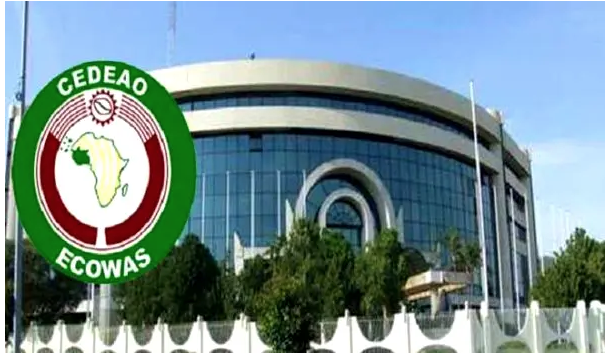
West African leaders have approved a new leadership team for the Economic Community of West African States (ECOWAS), appointing commissioners, judges and heads of key regional institutions as the bloc prepares for a new five-year administrative cycle amid growing security and economic challenges.
The appointments, endorsed during the 69th Ordinary Session of the ECOWAS Authority of Heads of State and Government in Lungi, Sierra Leone, will take effect for the 2026–2030 term and are expected to shape the organisation’s response to insecurity, regional trade, democratic governance and economic integration.
The decisions were announced in a communiqué issued after the summit, chaired by Sierra Leonean President Julius Maada Bio.
New Commissioners Named
The summit approved five new commissioners who will oversee some of ECOWAS’ most strategic portfolios.
The appointments include:
- Francess Alghali (Sierra Leone) – Political Affairs, Peace and Security
- Dehpue Zuo (Liberia) – Economic Affairs and Agriculture
- Dr Kalilou Sylla (Côte d’Ivoire) – Internal Services
- Amin Suleiman (Ghana) – Infrastructure, Energy and Digitalisation
- Prof. Nassirou Bako-Arifari (Benin) – Human Development and Social Affairs
The commissioners will play a central role in implementing ECOWAS policies as the regional bloc confronts rising insecurity, sluggish economic growth and renewed efforts to deepen regional integration.
Fresh Faces at the ECOWAS Court
Leaders also appointed five new judges to the ECOWAS Court of Justice, the regional court responsible for interpreting community law and adjudicating human rights and treaty-related cases.
The new judges are:
- Awa Bah (The Gambia)
- Charlyne Brumskine (Liberia)
- Désiré Aihou (Benin)
- Henrietta Didigu (Nigeria)
- Yaouza Ouro-Sama (Togo)
The appointments come at a time when the court continues to play an increasingly important role in resolving disputes involving member states and protecting citizens’ rights across the region.
Key Institutional Appointments
The summit also approved appointments to several specialised ECOWAS institutions.
Among those named were:
- Carla Bettencourt (Cape Verde) as Auditor-General of ECOWAS Institutions.
- Dr Palokinam Pitche (Togo) as Director-General of the West African Health Organisation (WAHO).
- Mam Jallow (The Gambia) as Director-General of the Inter-Governmental Action Group against Money Laundering in West Africa (GIABA).
The appointments are intended to strengthen oversight, regional public health coordination and financial crime prevention across the 15-member bloc.
Nigeria Yet to Fill Vice-President Position
Regional leaders also granted Nigeria an additional two weeks to nominate a candidate for the position of ECOWAS Commission Vice-President, which has been allocated to Africa’s largest economy.
The delay leaves one of the organisation’s most influential leadership positions temporarily vacant as consultations continue in Abuja.
Leadership Transition
The Authority paid tribute to outgoing ECOWAS Commission President Dr Omar Touray, commending his service during one of the organisation’s most turbulent periods, marked by military coups, political transitions and regional security crises.
Heads of State formally welcomed General Birame Diop of Senegal as the incoming President of the ECOWAS Commission, expressing confidence that his diplomatic and military experience would help steer the bloc through its next phase of reforms.
Why It Matters
The appointments come at a pivotal moment for ECOWAS.
The regional organisation is working to reinforce its relevance after a series of military takeovers across West Africa, growing terrorist violence in the Sahel and the withdrawal of Burkina Faso, Mali and Niger, which have formed the rival Alliance of Sahel States (AES).
At the same time, ECOWAS is seeking to accelerate implementation of regional trade agreements, improve infrastructure connectivity, strengthen democratic institutions and boost economic cooperation among remaining member states.
The incoming leadership will therefore inherit one of the most demanding agendas in the bloc’s nearly 50-year history, balancing institutional reform with efforts to restore regional unity and investor confidence.
For businesses, investors and citizens across West Africa, the effectiveness of the new leadership team could prove critical to the future of regional integration, cross-border trade and collective security.
—————————————————————————————————————————————
Your help to our media platform will support the delivery of the independent journalism and broadcast the world needs. Support us by making any contribution. Your donation and support allows us to be completely focus, deeply investigative and independent. It also affords us the opportunity to produce more programmes online which is a platform universally utilised.
Thank you.
Please click link to make – DONATION