

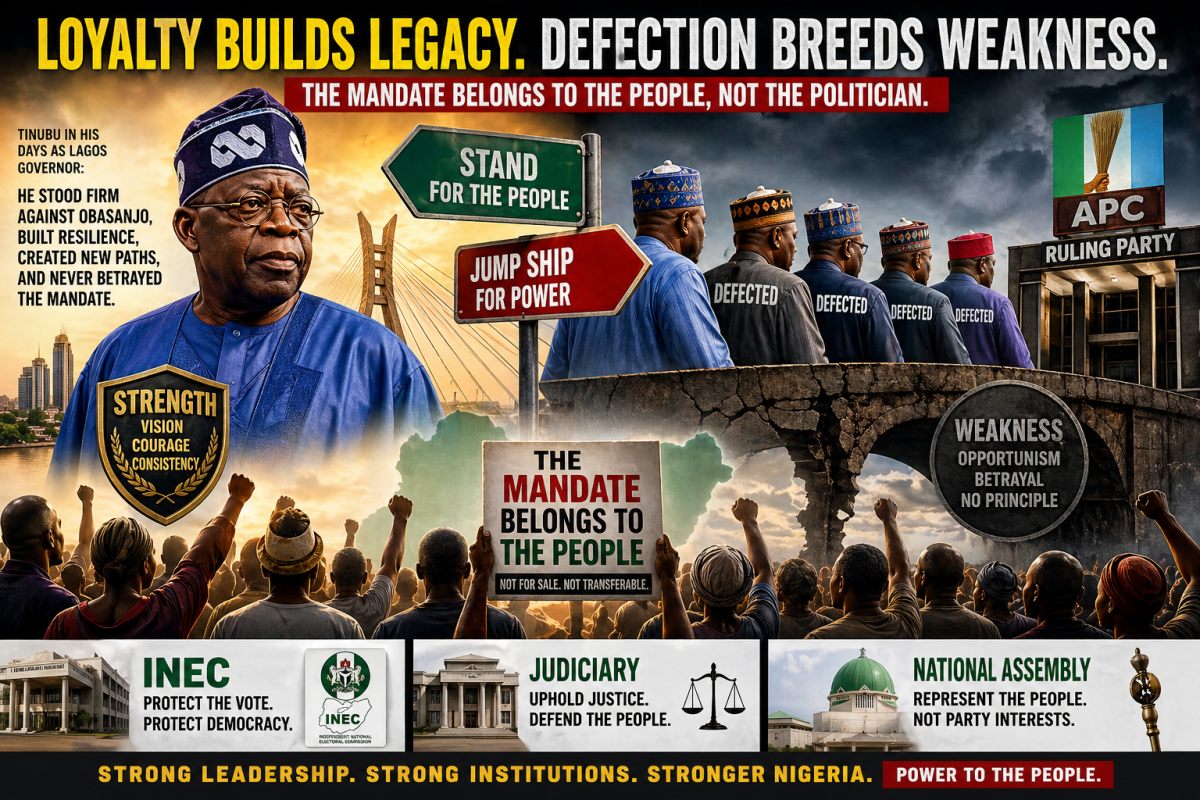
As Nigeria inches toward the 2027 elections, a political culture of convenience, not conviction is steadily taking root across the country. Governors, Senators, House Of Reps, State Execs, Local Govt to Wards elected on the mandate of the people, are increasingly treating party affiliation as a personal wardrobe choice: something to change when it no longer fits their ambitions.
Let us be clear, this is not strength. It is political weakness dressed up as strategy.
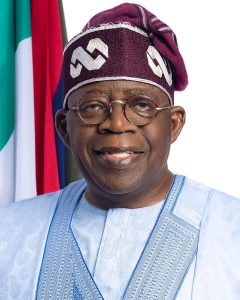 There was a time in Nigeria’s democratic journey when leadership meant standing firm, even under intense pressure. Bola Ahmed Tinubu, as Governor of Lagos State, faced a powerful federal government under President Olusegun Obasanjo. According to feelers, Lagos was financially squeezed, politically targeted, and institutionally challenged. Yet, rather than defect or capitulate, Tinubu held his ground. He built alliances, restructured opposition politics, and played the long game that would eventually reshape Nigeria’s political landscape and lead to the emergence of the All Progressives Congress.
That is what political strength looks like – resilience, strategy, and ideological consistency over time.
Today, many governors fall short of that standard. The growing wave of defections into the ruling All Progressives Congress is often justified under the excuse of “bringing development closer to the people.” But this argument collapses under scrutiny. Nigeria operates a federal system. No state should need to surrender its political identity to access development. If that is the reality, then what we have is not federalism: but subtle coercion.
And yet, evidence suggests otherwise.
States like Abia under Alex Otti of the Labour Party, Anambra under Charles Soludo of APGA, and Oyo under Seyi Makinde and Bauchi of the Peoples Democratic Party continue to function, develop, and in some cases outperform expectations without aligning with the ruling party at the centre. Their existence alone dismantles the myth that progress is reserved only for those who politically submit.
So why the defections?
The answer is uncomfortable: political survival, access, and in some cases, fear. But whatever the reason, one truth remains – the mandate does not belong to the governor. It belongs to the people.
When a politician is elected under one party and defects without returning to the electorate for a fresh mandate, it raises a fundamental moral question. Is the vote transferable? Can the will of the people be carried across party lines without their consent? Legally, the system may tolerate it. Ethically, it is deeply flawed.
This is where Nigeria’s democratic referees must answer hard questions.
 The Independent National Electoral Commission (INEC) is not just an election organiser; it is the guardian of voter trust. The judiciary must not only interpret the law but defend the spirit of justice. The National Assembly must remember that it exists to represent the people – not to enable political opportunism.
When these institutions fail to act decisively, they become silent enablers of democratic erosion.
At the same time, opposition parties – namely the Peoples Democratic Party, Labour Party, All Progressives Grand Alliance, New Nigeria Peoples Party, NDC, Accord, SDP, PRP, ZLP, YPP and others are within their rights to form alliances aimed at challenging the ruling party. That is democracy at work. Equally, the ruling party has every right to attract new members and consolidate power. Politics is, after all, a contest of interests.
But above all these actors stands one authority that must not be undermined—the Nigerian voter.
When voters are induced with short-term incentives, neglected after elections, or politically displaced through defections they did not endorse, democracy loses its meaning. Hunger-driven voting, desperation-driven politics, and elite-driven decisions cannot build a stable nation.
The comparison with other nations is instructive. Switzerland thrives on strong institutions and decentralised accountability. The United Kingdom sustains governance through political discipline and institutional respect. Even China, despite operating a one-party system, enforces rules with consequences. Leadership there is not left to whim, it is structured, monitored, and enforced.
Nigeria cannot continue to operate a system where rules are flexible, accountability is selective, and loyalty is transactional.
The road to 2027 will test not just parties and politicians, but the very soul of Nigeria’s democracy. The question is no longer who holds power – but how that power is acquired, exercised, and sustained.
In the end, leadership is not proven by how quickly one defects, but by how firmly one stands.
And democracy is not protected by politicians; it is protected by the people, if they choose to demand better.
MCA
—————————————————————————————————————————————
Your help to our media platform will support the delivery of the independent journalism and broadcast the world needs. Support us by making any contribution. Your donation and support allows us to be completely focus, deeply investigative and independent. It also affords us the opportunity to produce more programmes online which is a platform universally utilised.
Thank you.
Please click link to make – DONATION