

ECOWAS Approves $25bn Nigeria-Morocco Gas Pipeline Project
The Economic Community of West African States (ECOWAS) has approved the legal framework for the long-awaited $25 billion Nigeria-Morocco Gas Pipeline, clearing a major hurdle for one of Africa’s most ambitious cross-border energy projects.
The agreement was signed on Monday during the ECOWAS Summit in Sierra Leone, providing the legal foundation for the pipeline, which has been under discussion since Nigeria and Morocco first announced the initiative in 2016.
Sierra Leone’s President and current ECOWAS Chairman, Julius Maada Bio, welcomed the development with a light-hearted remark after the signing.
“Don’t be surprised when the gas comes your way,” he said.
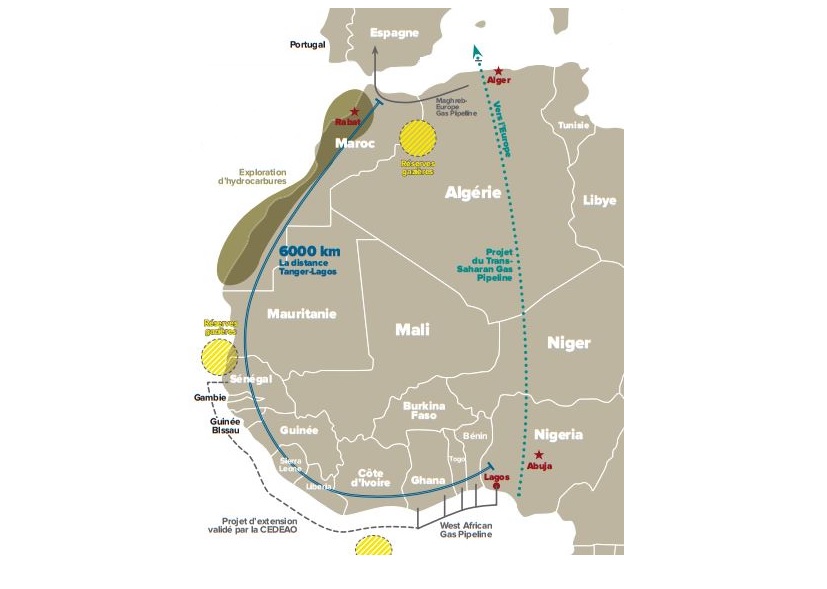
The proposed 6,000-kilometre pipeline will transport natural gas from Nigeria along Africa’s Atlantic coastline through several West African countries to Morocco. It will then connect with the existing Maghreb-Europe Gas Pipeline, enabling exports to Spain and other European markets.
Construction of the project is expected to begin in 2028.
According to Amina Benkhadra, Director General of Morocco’s National Office of Hydrocarbons and Mines (ONHYM), the pipeline is designed to transport 30 billion cubic metres of natural gas annually, with around 15 billion cubic metres earmarked for Morocco before onward delivery to Europe.
Benkhadra described the ECOWAS agreement as a critical milestone that transforms years of political commitment into a binding regional legal framework.
“The signing of this agreement marks the culmination of a long process of consultation,” she said, noting that member states had agreed on common rules covering governance, taxation, regulatory stability, investment protection and cross-border cooperation.
The pipeline is expected to pass through 13 African countries, in addition to Western Sahara, making regional coordination central to its success.
Benkhadra said all transit countries had participated in the project’s feasibility studies since 2017, while cooperation agreements had already been signed with national energy companies to coordinate engineering work and future implementation.
Although transit countries are expected to earn revenue through transit fees, industry experts say the project’s greatest significance lies in strengthening Africa’s energy security.
Energy expert Charles Majomi, a former adviser to the Nigerian government, said the pipeline could help reverse the long-standing practice of exporting Africa’s raw gas for processing abroad before importing refined products at significantly higher costs.
He described the current model as a “complete devaluation” of Africa’s natural resources and argued that the project would promote greater value addition within the continent.
Beyond exports, the pipeline is expected to expand access to reliable energy across West Africa, supporting electricity generation and industrial growth.
Benkhadra said the infrastructure would provide sustainable energy to countries seeking to accelerate electrification while supporting energy-intensive industries such as mining. She added that demand forecasts extending to 2050 had been incorporated into the project’s planning to ensure production capacity aligns with future regional energy needs.
Once completed, the Nigeria-Morocco Gas Pipeline is expected to become one of Africa’s largest energy infrastructure projects, strengthening regional integration while opening new export opportunities for Nigerian gas in European markets.
—————————————————————————————————————————————
Your help to our media platform will support the delivery of the independent journalism and broadcast the world needs. Support us by making any contribution. Your donation and support allows us to be completely focus, deeply investigative and independent. It also affords us the opportunity to produce more programmes online which is a platform universally utilised.
Thank you.
Please click link to make – DONATION