


A new report has suggested that the $5 trillion reparations demand against Britain and other former colonial powers may be only a fraction of the economic value of the damage inflicted on Africa during the colonial era.
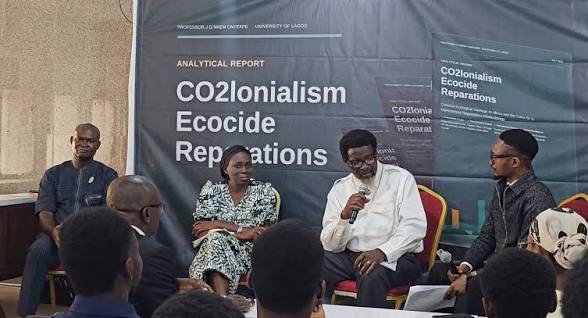
The report, titled “CO2lonialism-Ecocide-Reparations,” argues that Africa’s reparations campaign must go beyond slavery, human exploitation and historical economic losses to account for decades of environmental destruction, resource extraction and unequal economic exchange under colonial rule.
The report was unveiled on Friday at the University of Lagos by Professor J.G. Nkem Onyekpe, Head of the Department of History and Strategic Studies, before academics, legal experts and public activists.
Onyekpe said colonial rule created what could be described as an ecological debt, arising from the systematic appropriation of African land, natural resources and energy.
According to him, attaching a monetary value to those losses could dramatically increase the scale of Africa’s reparations claim.
He cited a peer-reviewed 2022 estimate which put the value of resources transferred from the Global South through unequal exchange at more than $10 trillion in 2015 alone.
Onyekpe argued that applying the same methodology retrospectively to the entire period of colonial rule and across affected African countries could produce a figure running into hundreds of trillions of dollars.
“If the same order of logic—that large-scale, structurally unequal appropriation of resources is capable of rigorous monetary valuation—were extended backward across the full duration of colonial rule and across the full set of affected African states, the resulting figure would run into the hundreds of trillions of dollars, and quite possibly beyond,” he said.
The scale of the potential claim was reinforced by a professor of geography at the event, identified as Professor Oscar, who said existing estimates of Africa’s colonial ecological losses may be significantly understated.
“Some people estimate the value of the damage to be $5 trillion, some say $20 trillion, others say $30 trillion. The value is far higher than that,” he said.
$5trn demand could be only a fraction
The report could significantly expand the scope of the $5 trillion reparations demand previously advanced by Nigerian Senator Ned Nwoko.
Nwoko had called on Britain and other former colonial powers to pay at least $5 trillion in reparations for the enduring consequences of colonial rule.
But the UNILAG report contends that once environmental destruction, resource extraction and unequal exchange are factored into the calculation, the $5 trillion figure could represent only a small portion of Africa’s potential claim.
The report is expected to be submitted to the African Union’s Committee of Experts on Reparations (AUCER) and Legal Reference Group on Reparations (AULER), as part of efforts to strengthen the continent’s emerging reparations framework.
Its authors argue that incorporating ecological damage into the reparations debate could give the African Union a broader framework for assessing the economic consequences of colonialism and developing a unified continental position.
Ecocide enters reparations debate
The report also places Africa’s reparations campaign within the growing international debate over ecocide and the legal consequences of large-scale environmental destruction.
The authors noted that developments since 2021, including work by the Independent Expert Panel on the legal definition of ecocide, European initiatives on serious environmental destruction and developments relating to the International Criminal Court, have strengthened the case for examining environmental devastation through the lens of international justice.
They also cited a July 2025 decision by the African Union to establish an ad hoc committee to examine the classification of the “massive destruction of environmental ecosystems” as a crime.
According to the authors, the move provides an important African institutional basis for bringing ecological destruction into the reparations debate.
Nauru case offers legal precedent
The report also draws on the Certain Phosphate Lands in Nauru case between Nauru and Australia at the International Court of Justice as evidence that environmental damage linked to colonial exploitation can form the basis of an international legal dispute.
The case involved extensive environmental degradation associated with phosphate mining during the colonial period.
Speaking at the report’s launch, jurisprudence and international law expert, Dr. Karibi-Whyte, said the Nauru case demonstrated that claims over colonial-era environmental destruction were not merely theoretical.
“The Nauru case proves that such claims are not merely theoretical but are grounded in established international law,” he said.
“Africa is now building on that precedent to address a harm that is orders of magnitude larger.”
The report therefore adds a new dimension to Africa’s expanding reparations campaign, shifting attention from the historical consequences of slavery and colonial exploitation to the enduring environmental and economic costs of resource extraction.
How much does colonial ecological debt cost?
For Nigeria and other African countries, however, turning the ecological-debt argument into an enforceable reparations claim could prove challenging.
Among the key questions would be how to accurately quantify decades of environmental destruction, determine the share attributable to individual colonial powers and establish a methodology capable of surviving legal, economic and historical scrutiny.
The African Union’s reparations mechanisms could consequently face the difficult task of developing a common framework for calculating ecological losses across countries with vastly different colonial histories and resource profiles.
The report comes against the backdrop of the AU’s broader reparations agenda, following its declaration of 2025 as the Year of Reparations and subsequent efforts to coordinate a common African position.
If the ecological-debt argument gains wider acceptance, Africa’s reparations campaign could move beyond the question of what former colonial powers owe for slavery and economic exploitation to a much larger question:
What is the present-day value of the natural resources extracted, wealth transferred and ecosystems destroyed during colonial rule?
The answer, according to the UNILAG report, could place Africa’s colonial reparations claim not at $5 trillion—but potentially in the hundreds of trillions of dollars.
—————————————————————————————————————————————
Your help to our media platform will support the delivery of the independent journalism and broadcast the world needs. Support us by making any contribution. Your donation and support allows us to be completely focus, deeply investigative and independent. It also affords us the opportunity to produce more programmes online which is a platform universally utilised.
Thank you.
Please click link to make – DONATION