


By ifeoma Onyekachi
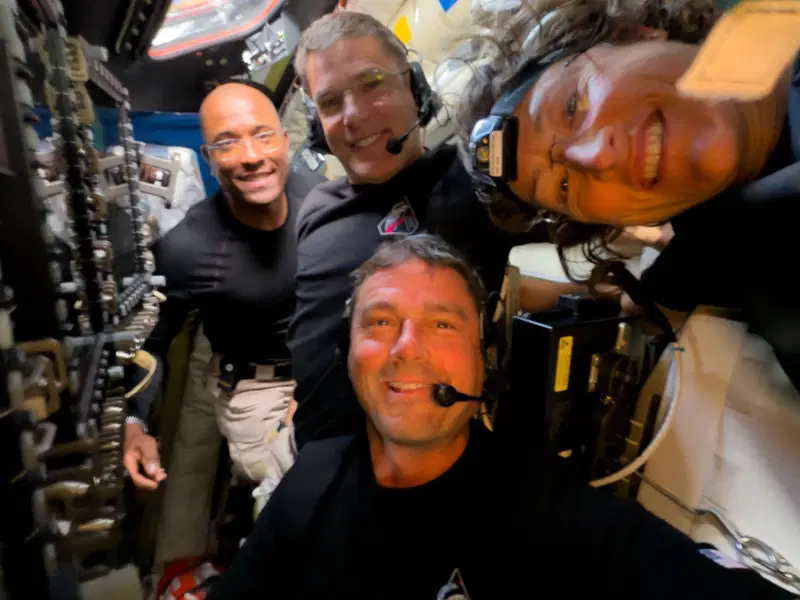
NASA celebrated a major milestone late Friday as four astronauts safely returned to Earth after completing the first crewed lunar flyby mission in more than five decades.
The spacecraft, part of the Artemis II programme, splashed down in the Pacific Ocean off the California coast, concluding a high-stakes test flight that delivered both critical data and striking images of the Moon.
Mission commander Reid Wiseman confirmed that all crew members including Christina Koch, Victor Glover and Jeremy Hansen were in stable condition following re-entry.
“They’re in great condition,” said NASA public affairs officer Rob Navias during the agency’s live broadcast.
Relief followed a tense communications blackout during atmospheric re-entry, a standard but critical phase of the mission. Contact was re-established shortly afterward, confirming the crew’s safe descent.
Recovery teams from NASA and the U.S. military retrieved the astronauts from the capsule, later transporting them by helicopter to a recovery vessel near San Diego. All four were able to walk unassisted upon arrival.
NASA Administrator Jared Isaacman described the mission as “a perfect success,” adding that it signals a renewed era of lunar exploration.
“We’re back in the business of sending astronauts to the Moon and this is just the beginning,” he said.
High-Risk Re-entry and Technical Validation
During re-entry, the spacecraft reached speeds exceeding 30 times the speed of sound and endured extreme temperatures approaching half that of the Sun’s surface. The descent served as a crucial test of the Orion capsule’s heat shield, following issues observed during a previous uncrewed mission.
Flight director Rick Henfling acknowledged the inherent risks. “If you didn’t feel anxiety bringing this spacecraft home, you probably didn’t have a pulse,” he said.
Despite those concerns, the re-entry proceeded without incident. The Orion capsule will now undergo detailed analysis to assess its performance.
A Historic Mission
The nine-day journey officially recorded by NASA as a 10-day mission began with a launch from Florida on April 1 and marked several historic firsts.
The crew travelled approximately 252,756 miles (406,771 kilometres) from Earth, the furthest distance reached by humans in space. Throughout the mission, they captured thousands of images, observed a solar eclipse, and documented meteorite impacts on the lunar surface.
The flight also marked key milestones in representation: Glover became the first person of colour to orbit the Moon, Koch the first woman, and Hansen the first non-American to undertake such a mission.
Astronomer Derek Buzasi described the mission as “an almost flawless success,” noting it had renewed confidence in the Artemis programme’s long-term goals.
Strategic Race to the Moon
The Artemis programme aims to establish a sustained human presence on the Moon, including the eventual construction of a lunar base to support deeper space exploration, including missions to Mars.
U.S. President Donald Trump praised the crew’s “spectacular” achievement and signaled ambitions beyond the Moon, writing: “Next step, Mars!”
NASA is targeting a crewed lunar landing as early as 2028, though analysts have expressed concerns about whether key technologies including landers being developed by SpaceX and Blue Origin will be ready in time.
Meanwhile, China is advancing its own lunar ambitions, aiming to land astronauts on the Moon by 2030.
Despite the competitive landscape, experts say Artemis II underscores the United States’ enduring capability in space exploration. Clayton Swope of the Center for Strategic and International Studies said the mission demonstrates that “when America keeps its eye on the prize, it can still achieve very great things.”
—————————————————————————————————————————————
Your help to our media platform will support the delivery of the independent journalism and broadcast the world needs. Support us by making any contribution. Your donation and support allows us to be completely focus, deeply investigative and independent. It also affords us the opportunity to produce more programmes online which is a platform universally utilised.
Thank you.
Please click link to make – DONATION