


The Federal Government has unveiled the National Digital Training Academy (DTA), a major national initiative designed to equip millions of young Nigerians with cutting-edge digital skills and globally recognised certifications in emerging technologies, as part of President Bola Ahmed Tinubu’s Renewed Hope Agenda for education, innovation and economic transformation.
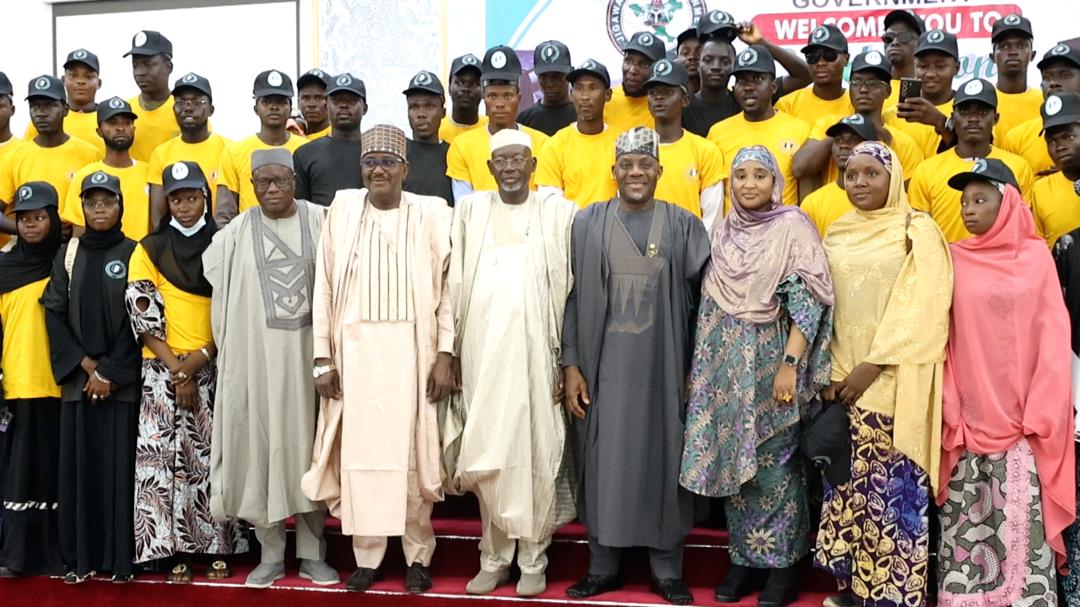
The announcement was made by the Minister of Education, Dr. Maruf Tunji Alausa, CON, during the graduation ceremony of 928 beneficiaries of a one-year professional diploma programme under the World Bank-assisted Innovation Development and Effectiveness in the Acquisition of Skills (IDEAS) Project in Jigawa State.
Dr. Alausa described the launch of the Digital Training Academy as a significant milestone in the Federal Government’s drive to build a highly skilled workforce capable of competing in the global digital economy.
According to him, the Academy will be implemented through a partnership between the Federal Ministry of Education and the Federal Ministry of Communications, Innovation and Digital Economy under the 3 Million Technical Talent (3MTT) programme.
The initiative will offer advanced training and internationally recognised certifications in high-demand fields including Artificial Intelligence, Machine Learning, Software Development, Cybersecurity, Cloud Computing, Product Management, IT Automation, Financial Technology, Natural Language Processing, Connected Technologies, Parallel Computing and Quantum Computing.
“The Digital Training Academy represents the next phase of Nigeria’s digital transformation journey. It is designed to provide young Nigerians with industry-relevant skills that will improve employability, encourage entrepreneurship and position the country as a major player in the global knowledge economy,” the Minister said.
Dr. Alausa noted that the graduation of 928 youths trained in Artificial Intelligence, Blockchain Technology, Cybersecurity, Software Engineering and Data Analytics demonstrates the growing impact of the Federal Government’s investment in digital skills development and Technical and Vocational Education and Training (TVET).
He said the Tinubu administration is prioritising skills acquisition as a central component of education reform, with ongoing efforts to modernise training institutions, expand access to quality vocational education and strengthen collaboration with industry to ensure graduates possess competencies required in the modern workplace.
The Minister also highlighted the Federal Government’s commitment to data-driven education planning through the National Education Data Infrastructure (NEDI) and the Digitalised Nigeria Education Management Information System (DNEMIS).
According to him, both platforms are transforming education governance by providing real-time data on enrolment, teacher deployment, school infrastructure and learner identification, enabling more effective planning, resource allocation and policy implementation.
Dr. Alausa commended Governor Umar Namadi of Jigawa State for his administration’s commitment to education, digital innovation and youth empowerment, describing the graduation ceremony as evidence of what can be achieved through strategic collaboration among governments, development partners, academic institutions and the private sector.
Governor Namadi, in his remarks, described the graduation as a major achievement in the state’s efforts to build a digitally empowered generation capable of driving economic growth and innovation.
He noted that the graduates had acquired practical skills in emerging technologies that would enable them to pursue careers in the global technology ecosystem, establish businesses and create employment opportunities.
The Governor praised the Federal Ministry of Education, the World Bank-assisted IDEAS Project and Baze University for partnering with the state government to deliver the programme and expand opportunities for young people.
As part of efforts to encourage excellence, Governor Namadi announced that 30 outstanding graduates would receive laptop computers from the state government, while four exceptional participants had already secured employment with Baze University.
He also unveiled the Jigawa State 12-Point Agenda Digital Portal, a technology-driven platform designed to provide citizens with real-time access to information on government projects and programmes across the state’s 27 local government areas and 287 political wards.
Speaking at the event, the Minister of State for Education, Professor Suwaiba Sa’id Ahmad, said the graduation reflects the Federal Government’s determination to raise a generation of digitally skilled, innovative and globally competitive Nigerians.
She commended the Jigawa State Government, the World Bank, the IDEAS Project, Baze University and other stakeholders for supporting the initiative and urged the graduates to continue learning, innovating and applying their knowledge to solving societal challenges.
Dr. Alausa congratulated the graduates and encouraged them to embrace lifelong learning, noting that the knowledge and skills they had acquired should serve as a foundation for creating solutions, building enterprises and contributing to national development.
He reaffirmed the Federal Government’s commitment to expanding access to quality TVET programmes, accelerating digital skills development through the newly launched National Digital Training Academy and strengthening partnerships that will position Nigeria as Africa’s leading hub for innovation, technology and skilled talent.
—————————————————————————————————————————————
Your help to our media platform will support the delivery of the independent journalism and broadcast the world needs. Support us by making any contribution. Your donation and support allows us to be completely focus, deeply investigative and independent. It also affords us the opportunity to produce more programmes online which is a platform universally utilised.
Thank you.
Please click link to make – DONATION