

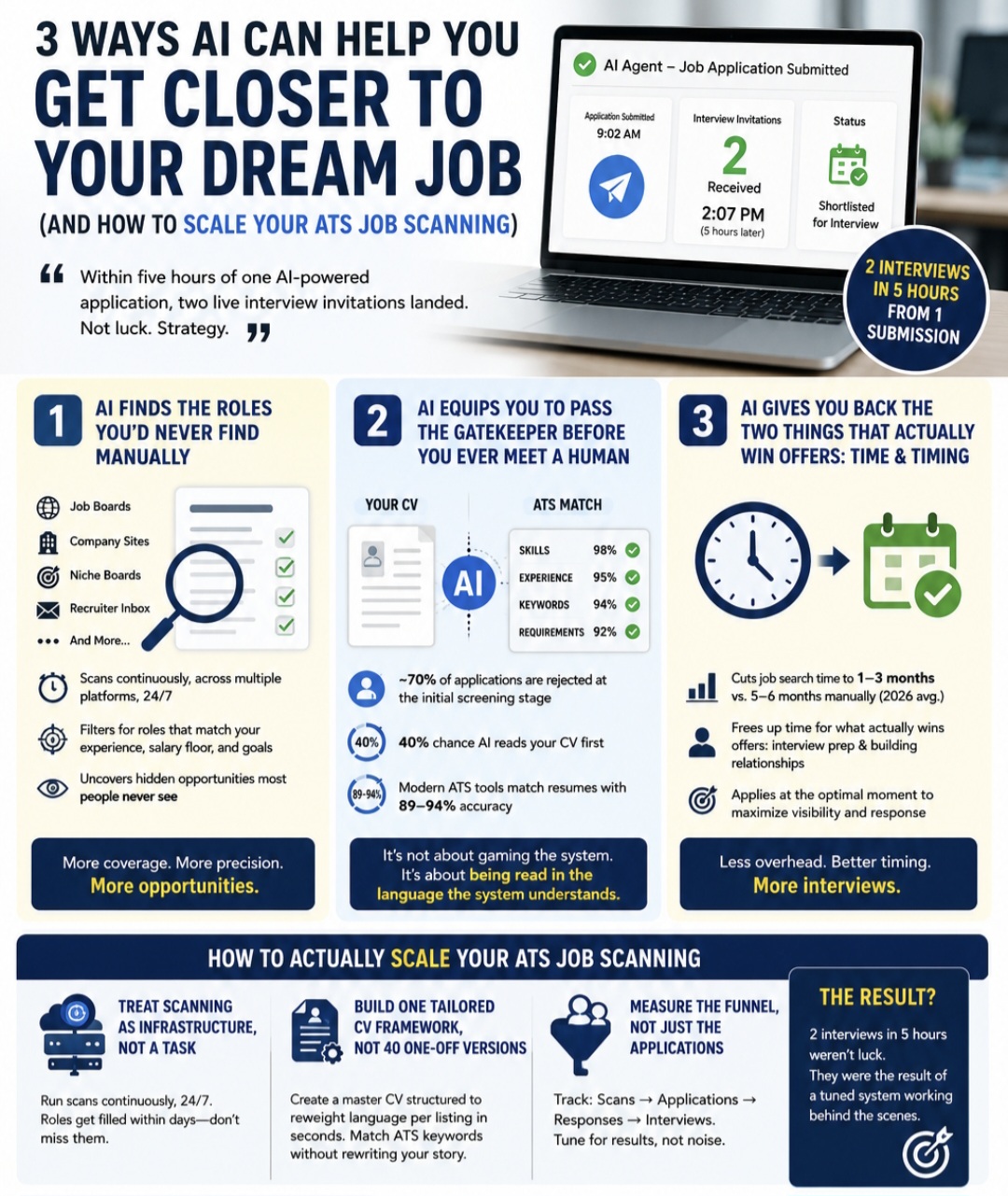
Earlier this week, I ran a live webinar in front of an audience watching in real time. Midway through, I pulled up a job application my AI agent had submitted that same morning. Within five hours of that single submission going out, two live interview invitations had landed. Not two days. Not two weeks. Five hours, for a role the agent had found, matched, and applied to without a human touching a keyboard.
I want to be precise about why that moment mattered, because it was not a magic trick. It was proof of something every job seeker needs to understand right now: the tools that recruiters have used to filter people out at scale are now available to use in the opposite direction, to get the right people in front of the right roles faster than the market is used to.
Here are three ways that shift plays out in practice, and what it takes to scale it properly.
- AI Finds the Roles You’d Never Find Manually
The average job seeker checks two or three job boards, scrolls for twenty minutes, and applies to whatever looks closest to a fit that day. That is not a search strategy. That is triage.
An AI agent does not get tired and does not stop at page two. It can scan listings continuously across multiple platforms, around the clock, and filter for the roles that actually match your experience, your salary floor, and your stated goals, rather than just the roles with the loudest job titles. The difference is not speed alone. It is coverage. You stop missing the roles that were never going to surface in a casual search because they were posted on a smaller board, behind a recruiter’s inbox, or twelve pages deep in a results list nobody scrolls to.
This is exactly what was running behind the scenes before that webinar demonstration. The agent had been scanning quietly for days. The audience only saw the five-hour result. They did not see the hundred decisions made beforehand to get the right application in front of the right system at the right moment.
- AI Equips You to Pass the Gatekeeper Before You Ever Meet a Human
Roughly 70% of all applications are rejected at the initial screening stage, often by a system, before a person reads a word of them. If your CV lands inside an enterprise Applicant Tracking System, there is at least a 40% chance AI reads it first, and modern screening tools now process resumes with 89 to 94% accuracy in matching candidates to listed requirements.
That is not a wall. It is a pattern, and patterns can be matched. AI can read a job description, identify the specific language the ATS has been trained to weight, and reshape your existing CV to mirror it honestly, surfacing experience you already have rather than inventing experience you don’t. This is the part people get nervous about, assuming it means lying to a machine. It does not. It means stopping the very real problem of a strong candidate being rejected because their CV described the same skill in different words than the one the system was told to look for.
Equipping yourself this way is not cheating the process. It is finally being read in the language the process was built to understand.
- AI Gives You Back the Two Things That Actually Win Offers: Time and Timing
The mechanical work of a job search, searching, formatting, tailoring, submitting, is not where offers are won. It is overhead. Every hour spent on it is an hour not spent preparing for the interview that actually decides the outcome.
Job seekers using AI strategically are cutting search time down to one to three months, against a 2026 average of five to six months for a manual search. That gap is not marginal. It is roughly half the time spent unemployed or underemployed, recovered and reinvested elsewhere.
Timing matters just as much as time saved. The agent behind the webinar demonstration didn’t just apply, it applied at the moment most likely to get attention, then surfaced the result automatically the next morning. Two shortlistings within five hours were not luck. They were the byproduct of removing the lag between “the right role appears” and “your application lands in front of someone.”
How to Actually Scale Your ATS Job Scanning
Most people who hear “AI job search agent” picture a single bot sending a single application. Scaling it properly looks different, and it comes down to three disciplines.
First, treat scanning as infrastructure, not a task. A scan you run once a week will always lose to a system running continuously, because roles get filled within days of posting, often before a manual searcher has even seen them.
Second, build one tailored CV framework, not forty one-off versions. The goal is a master document structured so an agent can reweight language per listing in seconds, matching ATS keyword patterns without rewriting your story from scratch every time.
Third, measure the funnel, not just the applications. Track how many scans become applications, how many applications become responses, and how many responses become interviews. That is the only way to know whether your scanning is actually working or just generating noise. The two interviews that came in five hours after one submission were not the first thing the system produced. They were the visible result of a funnel that had already been tuned.
The Bigger Point
What I demonstrated in that webinar was not about one lucky application. It is the opportunity available now , before it becomes known by all . Employers have been scanning, scoring, and automating against candidates for years. The candidates now building the same capability for themselves are not gaming the system. They are simply, finally, playing the same game the other side has been playing all along.
Sam Onigbanjo builds practical AI systems for job search, trading, and business automation, and recently demonstrated a live AI job application agent that generated two interview invitations within five hours of a single submission.
Follow him at www.aiacademyforbeginners.com or on linkedin https://www.linkedin.com/in/samonigbanjo/
Sources:
- AI in Recruiting and Hiring Statistics 2026
- 121 AI in Recruitment and Hiring Statistics for 2026
—————————————————————————————————————————————
Your help to our media platform will support the delivery of the independent journalism and broadcast the world needs. Support us by making any contribution. Your donation and support allows us to be completely focus, deeply investigative and independent. It also affords us the opportunity to produce more programmes online which is a platform universally utilised.
Thank you.
Please click link to make – DONATION