

By ifeoma Onyekachi
Negotiations between the United States and Iran aimed at ending the escalating Middle East conflict have ended without a breakthrough, with Washington presenting what it described as a “final and best offer” to Tehran.
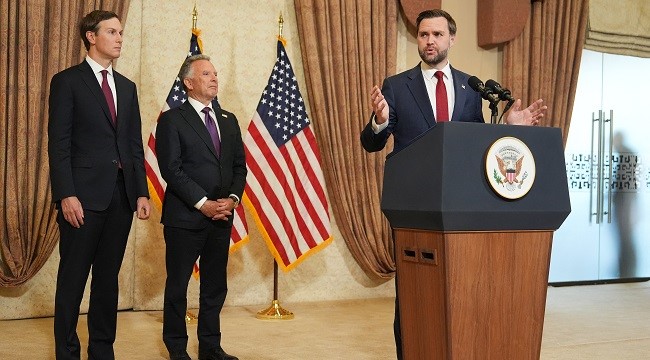
US Vice President JD Vance disclosed on Sunday that the high-level talks in Islamabad concluded without agreement after nearly 21 hours of intense deliberations. The meeting marked the most senior direct engagement between both countries since the 1979 Islamic Revolution.

“We leave here with a very simple proposal… our final and best offer. We’ll see if the Iranians accept it,” Vance told reporters before departing Islamabad.
Core Dispute: Nuclear Commitments
Washington said its primary demand remains a binding assurance that Iran will not develop nuclear weapons. However, Vance noted that such a “fundamental commitment” was not secured during the talks.
Iran, on the other hand, accused the US of imposing “unreasonable demands,” according to state broadcaster Islamic Republic of Iran Broadcasting. Tehran’s foreign ministry later struck a more measured tone, acknowledging that resolving decades of hostility in a single session was unrealistic.
Background to the Conflict
The current war erupted on February 28 following coordinated strikes by the United States and Israel on Iranian targets, triggering swift retaliation from Tehran. The confrontation has since destabilised the region and rattled global energy markets.
Tensions have been particularly acute around the Strait of Hormuz, a strategic maritime corridor through which roughly one-fifth of global oil supply typically passes. Iran’s effective closure of the route during the conflict sent oil prices surging and intensified global economic uncertainty.
Strategic Pressure and Military Posturing
In a show of force, the US deployed naval assets to the region, including minesweeping vessels aimed at securing the waterway. However, Iran denied that American warships had entered the strait and warned of retaliation if they did.
The Iranian Revolutionary Guard stated that any safe passage guarantees during the temporary ceasefire would apply only to civilian vessels under strict conditions.

Meanwhile, US President Donald Trump maintained a defiant stance, claiming military success regardless of the diplomatic outcome.
“Whether we make a deal or not makes no difference… we’ve won,” Trump said during the talks.
Pakistan’s Mediation Role
Pakistan, which hosted the negotiations, has positioned itself as a key mediator. Foreign Minister Ishaq Dar urged both sides to maintain the fragile ceasefire and continue dialogue.
“It is imperative that the parties uphold their commitment to ceasefire,” Dar said, pledging continued diplomatic engagement.
Sticking Points: Sanctions and Regional Conflicts
Iran’s demands include the unfreezing of sanctioned assets and an end to Israeli military operations against Hezbollah in Lebanon conditions Washington has refused to consider within the current negotiation framework.
Iranian Parliament Speaker Mohammad Bagher Ghalibaf, who led Tehran’s delegation alongside Foreign Minister Abbas Araghchi, expressed deep skepticism about US intentions, citing a history of “broken promises.”
Lebanon: A Parallel Flashpoint
Complicating matters further, Israel has continued its military campaign in Lebanon against Hezbollah, despite the broader ceasefire dynamics. Lebanese authorities report that Israeli strikes have killed over 2,000 people since the conflict began.
Israeli Prime Minister Benjamin Netanyahu said his government is seeking a long-term peace arrangement with Lebanon but ruled out any ceasefire with Hezbollah for now.
Uncertain Path Forward
While both sides have left the door open for further engagement, the gap between Washington and Tehran remains wide. Analysts note that mutual distrust, conflicting strategic interests, and regional proxy conflicts continue to undermine prospects for a swift resolution.
For now, the world watches closely as diplomacy struggles to keep pace with a conflict that carries significant geopolitical and economic consequences.
—————————————————————————————————————————————
Your help to our media platform will support the delivery of the independent journalism and broadcast the world needs. Support us by making any contribution. Your donation and support allows us to be completely focus, deeply investigative and independent. It also affords us the opportunity to produce more programmes online which is a platform universally utilised.
Thank you.
Please click link to make – DONATION