

THE 2026 RACE IS FAR MORE OPEN THAN IT APPEARS
The contest to succeed António Guterres as Secretary-General of the United Nations should not yet be regarded as settled.
The first Security Council straw poll produced a clear early leader in Rebeca Grynspan of Costa Rica, with 10 “encourage” votes, followed by Carolyn Rodrigues-Birkett with nine and Rafael Grossi with seven. Michelle Bachelet and Macky Sall received six each, María Fernanda Espinosa five and Olara Otunnu two. The results were encouraging for some candidates but also demonstrated that no contender had yet secured a clear consensus. The poll was informal, secret and non-binding, with the positions of the five permanent members not yet identifiable.
That distinction matters.
The Secretary-General is not chosen through a conventional election in which an early lead determines the outcome. The Security Council must ultimately recommend a candidate to the General Assembly, with at least nine affirmative votes and no veto from a permanent member. The process can therefore reward not only the strongest early contender, but also the candidate capable of building the broadest eventual acceptance.
It is within that space that the potential candidature of Nigerian citizen nominated by an African Think Tank deserves serious consideration.
A DIFFERENT LEADERSHIP PROPOSITION
They nominated Queen Akasoba Zainab Duke-Abiola – does not need to compete by attempting to replicate the résumé of every established contender.
Her potential strength lies in offering something different: a multidisciplinary leadership profile combining law, governance, diplomacy, security and strategic affairs, sustainable development, public policy, international relations, academia and public service.
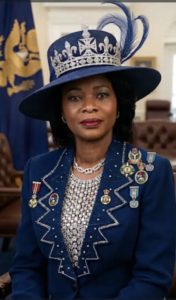 Her formation as a Distinguished Member of the National Institute (mni) adds a strategic-policy dimension to that profile, bringing together questions of security, economics, governance, development and statecraft.
The proposition is therefore one of convergence.
The contemporary UN cannot separate conflict from development, migration from security, climate from stability, human rights from governance or economic opportunity from peace.
The next Secretary-General will need to understand these connections and, more importantly, translate them into diplomacy capable of bringing different interests together.
That is where Duke-Abiola can begin to distinguish her potential candidature.
THE EXISTING FIELD — STRONG CANDIDATES, BUT NO FINAL CONSENSUS
Rebeca Grynspan has established the strongest early numerical position and that advantage should be acknowledged. Her extensive international and UN experience makes her a formidable contender. Yet 10 “encourage” votes in a first informal poll do not constitute a final mandate, particularly while the P5 positions remain undisclosed.
Rodrigues-Birkett’s nine votes demonstrate that the lead is narrow.
Grossi brings exceptional international standing and specialist expertise through the IAEA, but the Secretary-General’s mandate extends considerably beyond nuclear security.
Bachelet brings exceptional national and international experience, including the presidency of Chile, leadership of UN Women and service as UN High Commissioner for Human Rights. However, Chile withdrew its nomination in March, while Brazil and Mexico continue to support her. Her first straw-poll result also showed significant reservations within the Council.
Sall brings presidential and international experience, but his first poll produced six “encourage” against seven “discourage” votes.
Espinosa remains a serious contender, although her five encouragements alongside eight “no opinion” votes indicate substantial diplomatic space still to be developed.
Otunnu’s late entry is perhaps the most useful reminder for those assessing the dynamics of the race. Uganda nominated him only on 24 July, yet he was included in the first poll. His entry demonstrates that the field can evolve even at a relatively advanced stage.
The lesson is not that any of these distinguished individuals should be dismissed.
It is that the race remains capable of changing.
THE QUESTION OF NIGERIA
Duke-Abiola’s most important obstacle is also the clearest: Nigeria has not formally nominated her.
The endorsement of her potential candidature by the African Policy and Research Consortium can provide intellectual and continental momentum, but it cannot substitute for formal nomination by a UN Member State. The UN maintains an official list of nominated candidates and identifies the nominating states.
That makes the next step fundamentally political and diplomatic.
Should Nigeria decide to nominate Duke-Abiola, her status would change immediately from a potential contender supported by an organised constituency to an officially submitted Nigerian candidature.
That would create a very different conversation.
Nigeria is one of Africa’s most significant diplomatic, economic and peace-and-security actors. Its decision would therefore carry meaning beyond the individual candidate.
A Nigerian nomination could place before the international community a proposition built around bridging:
Africa and the wider world;
Global North and Global South;
security and sustainable development;
law and diplomacy;
institutional reform and continuity;
economic progress and human dignity.
THE CONSENSUS ALTERNATIVE
The most interesting possibility is therefore not necessarily that Duke-Abiola must enter the race as the strongest candidate from the outset.
It is that she could emerge as a consensus alternative if the established field proves unable to command sufficient support across competing geopolitical interests.
UN Secretary-General selections have always involved diplomacy, negotiation and the search for an acceptable candidate. The eventual choice must satisfy the Security Council’s voting requirements while avoiding a veto from any of the five permanent members.
In such an environment, an early frontrunner can encounter obstacles, while a candidate initially regarded as an alternative can gain relevance.
This is the strategic space Duke-Abiola could occupy.
Not as a candidate defined by opposition to others.
Not simply as an African candidate seeking regional representation.
But as a potential bridge candidate offering breadth, balance and a different model of global leadership.
THE WINDOW REMAINS OPEN
The second informal Security Council poll is currently being targeted for 21 August 2026, although the timetable can change.
The immediate question, therefore, is not whether Duke-Abiola has already won a contest she has not formally entered.
It is whether Nigeria sees an opportunity to place a distinctive African leadership proposition before the international community while the field remains fluid.
Her potential candidature should consequently be judged not merely by where she would begin, but by what she could become capable of building.
The strongest case is not that she is better than every other distinguished contender.
It is that she brings a different combination of experiences and perspectives at a moment when the United Nations itself is searching for renewed credibility, effectiveness and relevance. The Financial Times has described the incoming Secretary-General as facing an institution under significant pressure from geopolitical deadlock, financial strain and questions about its global authority.
That is precisely why a multidisciplinary, bridge-building leadership proposition deserves consideration.
AKASOBA ZAINAB DUKE-ABIOLA, mni
A Nigerian.
An African.
An internationalist.
A jurist and strategist.
A bridge-builder.
Not yet a formally nominated candidate — but potentially a candidate capable of changing the conversation.
PEACE. TRUST. HUMAN DIGNITY.
—————————————————————————————————————————————
Your help to our media platform will support the delivery of the independent journalism and broadcast the world needs. Support us by making any contribution. Your donation and support allows us to be completely focus, deeply investigative and independent. It also affords us the opportunity to produce more programmes online which is a platform universally utilised.
Thank you.
Please click link to make – DONATION