



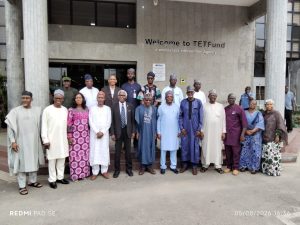
The Executive Secretary of the Tertiary Education Trust Fund, Sonny Echono, has reaffirmed the Fund’s commitment to transforming Nigeria’s scientific and technological landscape through the establishment and equipment of six multi-purpose zonal laboratories across the country’s geopolitical zones.
Echono made the remarks while receiving the report of the Advisory Committee on the Equipment of the TETFund Central Multi-Purpose Zonal Laboratories in Abuja.
He described the project as a long-awaited national intervention aimed at restoring Nigeria’s scientific pride, reducing dependence on foreign laboratories and stimulating industrial transformation through cutting-edge research infrastructure.
According to him, the idea of establishing zonal laboratories was first conceived over a decade ago but was shelved at the final implementation stage when government opted instead to establish new federal universities in states without one.
“There is nothing like an idea whose time has come,” Echono stated, noting that recent developments had shown the urgent need for world-class scientific facilities in Nigeria.
He lamented that critical samples are still routinely sent abroad to countries such as the United Kingdom, South Africa and even Ghana for analysis due to inadequate local facilities.
The TETFund boss recalled the challenges experienced during the COVID-19 pandemic, when delays in obtaining test results exposed weaknesses in the nation’s research and laboratory infrastructure.
“You remember what transpired during the COVID pandemic where it was taking five days or one week to get results because of lack of facilities. Within that period, infections could spread widely before detection,” he said.
Echono explained that the laboratories would complement several innovation hubs already being established by TETFund, including specialized facilities in mining, artificial intelligence and information technology.
He disclosed that the projects were being implemented in phases due to funding limitations, adding that four of the laboratories are expected to be completed between August this year and February next year.
According to him, Bayero University Kano, one of the first beneficiaries, has assured TETFund that its facility would be ready before August, making it the first to receive equipment installation.
He stressed the need for proper governance and sustainability structures to ensure the laboratories are effectively managed and maintained.
Part of the sustainability strategy, he said, would involve strong partnerships with industries and private sector operators to support semi-commercial activities capable of boosting operational efficiency and long-term viability.
“We envisage a situation where these facilities, though located within universities, will operate in a quasi-autonomous manner with separate governance arrangements that enable linkages, partnerships and other commercial activities,” Echono added.
Earlier, Chairman of the Advisory Committee, Chris Jibreel Maiyaki, said the committee was inaugurated on February 17, 2026 and tasked with advising TETFund on the most efficient and effective equipment required for the six laboratories.
Maiyaki said the committee reviewed several key documents, including reports dating back to 2011, and conducted verification visits to the six host institutions: Bayero University Kano, Yakubu Gowon University Abuja, the University of Lagos, the University of Maiduguri, the University of Nigeria Nsukka, Enugu Campus, and the University of Port Harcourt.
He revealed that construction progress varied significantly across the institutions, with Bayero University Kano reaching about 80 percent completion, while the University of Maiduguri and the University of Nigeria facilities were still at early stages.
The committee, he said, strongly recommended that equipment procurement be synchronized with the readiness of the buildings to avoid damage to highly sensitive scientific instruments.
“The deployment of advanced and expensive scientific instrumentation into incomplete or unprepared facilities would not only be ill-advised but could expose these national assets to irreversible damage,” he warned.
Maiyaki explained that the committee developed a comprehensive multidisciplinary equipment list covering physical sciences, engineering, life sciences, computing, workshop equipment and high-performance computing systems.
He said the laboratories were conceived as strategic national assets capable of addressing Nigeria’s longstanding deficit in scientific infrastructure and improving postgraduate research output, innovation and technological development.
According to him, the committee also proposed a governance framework and operational model designed to ensure international accreditation, efficient management and sustainable operations.
“These are not mere laboratories. They are Nigeria’s answer to a longstanding deficit in scientific infrastructure that has compelled our researchers to depend on foreign facilities,” he said.
Maiyaki commended the leadership of Echono for conceiving what he described as a bold and historic national project, adding that the laboratories could become one of TETFund’s most defining contributions to Nigeria’s scientific advancement.
He expressed optimism that once fully operational, the facilities would serve not only Nigeria but the wider global scientific community with distinction.
—————————————————————————————————————————————
Your help to our media platform will support the delivery of the independent journalism and broadcast the world needs. Support us by making any contribution. Your donation and support allows us to be completely focus, deeply investigative and independent. It also affords us the opportunity to produce more programmes online which is a platform universally utilised.
Thank you.
Please click link to make – DONATION