

On Nigeria’s Armed Forces Remembrance Day, the public attention given this Governor in Nigeria carries a symbolism that goes beyond ceremony. A former Nigerian Army officer turned civilian governor, this governor represents a category of leaders whose authority is shaped as much by discipline and command experience as by electoral legitimacy. In his State, that background has increasingly been defining both his governing style and his policy priorities.
 Since assuming office in May 2023, Kefas has focused on restoring state confidence through security stabilisation, infrastructure delivery and economic re-engagement. His military past is not treated as nostalgia, but as a framework for execution: structured planning, clear delegation and an insistence on outcomes. This approach has become more visible as his administration moves from early consolidation into longer-term positioning.
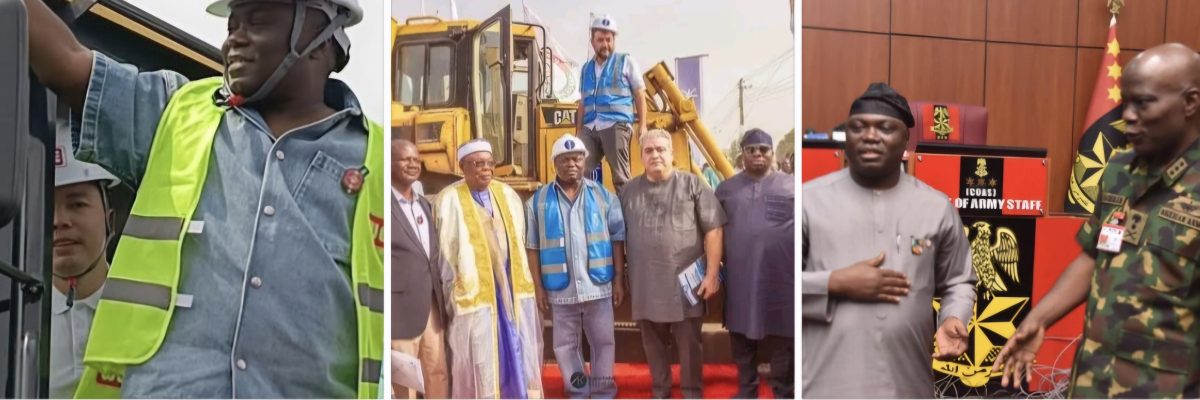
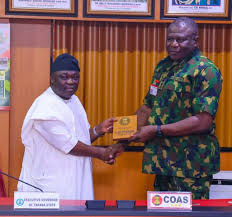 At the 2026 Armed Forces Remembrance Day observance in Jalingo, the governor publicly commended the Nigerian Army’s 6 Brigade and other security agencies for maintaining relative stability across parts of the state that were previously prone to communal and criminal disruption. The remarks were not symbolic alone. Security, in Kefas’s policy thinking, is an economic enabler. Roads, farms, markets and investments cannot function without predictable order, and his administration has treated civil–military cooperation as a development necessity rather than a temporary intervention.
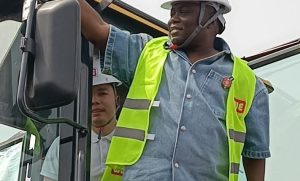 That logic has translated into a notable acceleration in capital projects. In January 2026, the state government flagged off multiple road and bridge projects valued at over ₦134bn, targeting connectivity between agricultural zones, border communities and commercial centres.
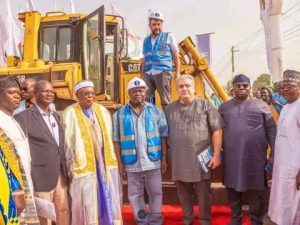
For a state long constrained by terrain and underinvestment, these links are designed to reduce post-harvest losses, lower transport costs and integrate local economies into wider regional markets.
Beyond scale, the projects signal a shift in how Taraba presents itself. Rather than isolated interventions, the administration has framed infrastructure as part of an economic system: roads that serve farming clusters, bridges that support trade routes, and urban works that improve the investment environment. This framing was reinforced by the governor’s repeated emphasis on “people-oriented projects”, a phrase that in practice has meant prioritising access and utility over visibility.
 The clearest expression of Taraba’s repositioning came last year with the state’s first major international investment summit.
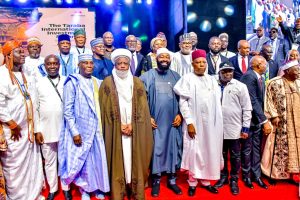
The event drew senior Nigerian business figures, including representatives linked to large industrial and financial groups, alongside diplomats and development partners. While the summit itself was symbolic, the policy signals behind it were substantive: land availability with documentation, streamlined approvals, fiscal incentives and security assurances tailored to investors rather than aspirational brochures.
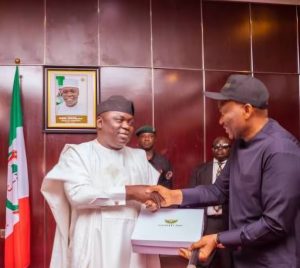
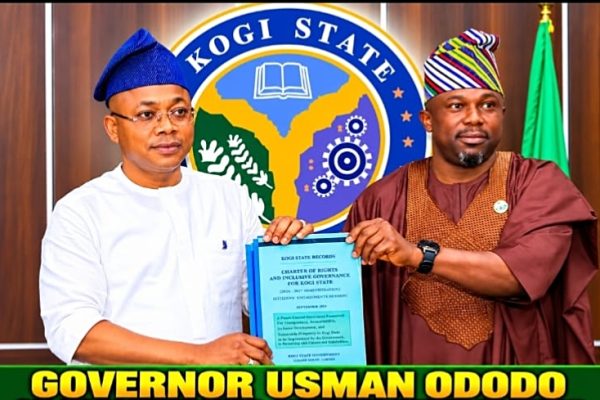
Hon Ndudi Elumelu handover document to Gov. Kefas
For a state often viewed through the lens of humanitarian need rather than commercial opportunity, the summit marked a deliberate reframing. Agriculture, solid minerals, logistics and renewable energy were presented not as abstract potential but as bankable sectors, supported by policy clarity.
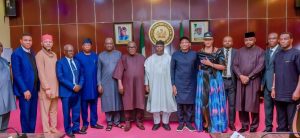
TARAVEST COMMITTEE
The administration has since maintained engagement with private capital, seeking partnerships rather than one-off announcements.
Kefas’s leadership style has been central to this effort. Observers note a preference for delegation to technocrats and sector leads, with an emphasis on measurable delivery. The governor has repeatedly stressed the importance of empowering trusted lieutenants to manage resources, oversee projects and attract opportunities, a model more akin to institutional management than personality-driven governance.
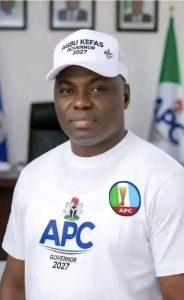 Politically, the governor’s recent realignment ahead of the 2027 cycle has been widely noted, though his public posture remains focused on performance rather than partisanship. The administration has continued to court federal agencies, investors and international partners with a message of continuity and openness. For many stakeholders, the test will not be rhetoric but whether project execution and fiscal discipline remain consistent as political pressures increase.
What distinguishes Kefas in Nigeria’s crowded political landscape is not ambition alone, but a method shaped by service. His military career has informed a governance philosophy that prioritises order, structure and accountability, while recognising that economic growth requires trust, infrastructure and human capital.
As Nigeria reflects on the sacrifices of its armed forces, Taraba’s experience under Governor Kefas offers a case study in how service backgrounds can translate into civilian leadership. The state’s trajectory remains a work in progress, but its direction is clearer than it has been: toward stability, openness and managed growth. For investors and policymakers alike, that clarity may prove to be Taraba’s most valuable asset.
—————————————————————————————————————————————
Your help to our media platform will support the delivery of the independent journalism and broadcast the world needs. Support us by making any contribution. Your donation and support allows us to be completely focus, deeply investigative and independent. It also affords us the opportunity to produce more programmes online which is a platform universally utilised.
Thank you.
Please click link to make – DONATION