

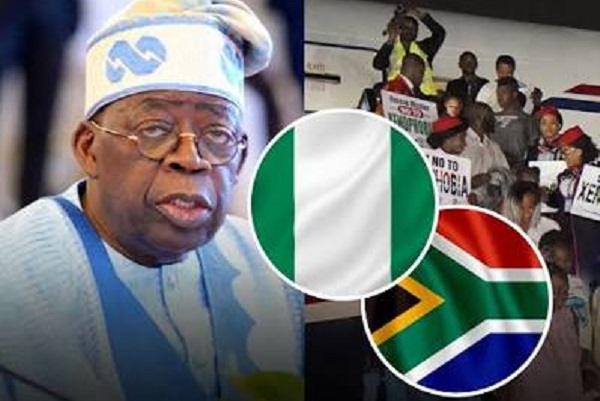
The Federal Government has demanded justice for Nigerians killed in xenophobic attacks in South Africa and called for adequate compensation for victims whose businesses were destroyed, properties looted and livelihoods disrupted.
The government also maintained that while diplomacy remained its preferred approach to resolving the issue, “all options” remained open in responding to the recurring attacks.
Minister of State for Foreign Affairs, Sola Enikanolaiye, disclosed that at least 98 Nigerians had been killed in xenophobic and Afrophobic attacks in South Africa over the past four years.
He said the government was compiling a comprehensive record of losses suffered by Nigerians living in South Africa with the aim of presenting compensation claims to the South African government.
According to the minister, the claims cover deaths, destruction of businesses and properties, and other losses suffered by Nigerians during the attacks.
He alleged that South African authorities either failed to prevent the attacks or, in some instances, security personnel were directly involved or failed to intervene while the violence occurred.
The attacks also forced more than 1,400 Nigerians to return home, while nationals of other African countries, including Ghana, Malawi, Botswana, Namibia, Mozambique and Zimbabwe, were similarly targeted.
Enikanolaiye met on Monday in Abuja with South African President Cyril Ramaphosa’s Special Envoy and Minister of International Relations and Cooperation, Ronald Lamola, to convey Nigeria’s concerns over the treatment of its citizens.
Briefing journalists after updating President Bola Tinubu on the outcome of the meeting, the minister said the attacks reflected a troubling pattern of anti-migrant violence.
“We have seen a pattern that has become a concern to the Nigerian government,” he said, noting that outbreaks of xenophobic violence had persisted since 1995, with official records indicating that 98 Nigerians had been killed in mob and hate-related attacks since 2022.
He stressed that, under international law, protests could not justify attacks on foreign nationals.
“We made it very clear. And he (the special envoy) agreed with us,” Enikanolaiye said.
On compensation, the minister acknowledged that no agreement had yet been reached but said the government had distributed claims forms to affected Nigerians to document their losses.
“You can’t even make a claim unless you know exactly the volume and distribution of those who are making those claims,” he said.
Enikanolaiye recalled that compensation had been a contentious issue during previous bilateral discussions between both countries.
“When I was Permanent Secretary, almost 10 years ago, we insisted that there must be a clear provision for compensation. They came back with a formulation that spoke about insurance claims,” he said.
He added that Lamola had pointed to South Africa’s legal framework for seeking redress over property damage, but Nigeria would proceed with its claims once its verification exercise was completed.
“We regard this as a work in progress. Despite the ongoing discussions, we will submit our claims when we complete the verification process on our side,” the minister said.
—————————————————————————————————————————————
Your help to our media platform will support the delivery of the independent journalism and broadcast the world needs. Support us by making any contribution. Your donation and support allows us to be completely focus, deeply investigative and independent. It also affords us the opportunity to produce more programmes online which is a platform universally utilised.
Thank you.
Please click link to make – DONATION