


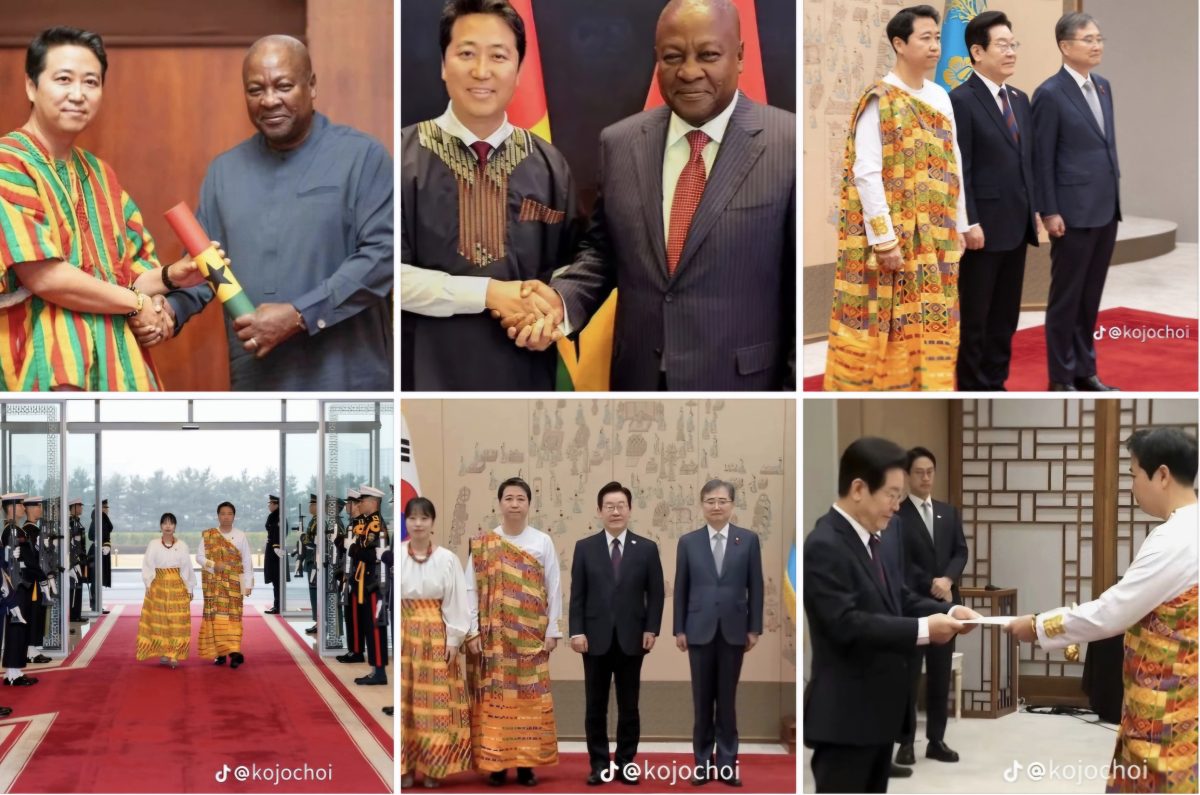
 When Ghana appointed Kojo Choi as its Ambassador to South Korea, it made a diplomatic statement that goes beyond symbolism and enters the realm of modern statecraft.
 Kojo Choi was born in Chuncheon, South Korea, in 1978 as Choi Seung Eub. As a teenager, he relocated to Ghana with his father, Reverend John Choi, a missionary, and became a naturalised Ghanaian citizen at the age of 14. He completed his secondary education in Ghana, went on to study at the University of Ghana, Legon, and later the University of Ghana Business School, building his professional life in the country as a fintech entrepreneur.
 Decades later, he returned to his country of birth not as a Korean citizen, but as Ghana’s official diplomatic representative, formally presenting his letter of credence to the President of South Korea while wearing traditional Ghanaian kente cloth.
 What makes this appointment exceptional is not diversity for its own sake, but its rarity in global diplomatic practice. Ambassadors are typically either citizens by birth of the appointing country or members of its diaspora representing an ancestral homeland.
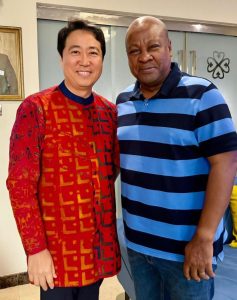
President John and Kojo
It is also noteworthy that Kojo Choi is neither a career diplomat nor a known political figure within Ghana’s ruling establishment. He is best known as a technology and fintech entrepreneur, rather than a foreign service professional. In global diplomatic practice, such appointments are not unprecedented. Governments occasionally deploy non-career ambassadors to key countries where trade, investment, technology transfer, or strategic economic partnerships are prioritised alongside traditional diplomacy. In that sense, Ghana’s choice may also reflect a broader emphasis on economic diplomacy and private-sector engagement, particularly in a country like South Korea, which is central to global technology, manufacturing, and capital flows.
Kojo Choi fits neither category. He was not Ghanaian by birth, nor part of a Ghanaian diaspora abroad, but became Ghanaian by law, lived experience, and long-term national contribution.
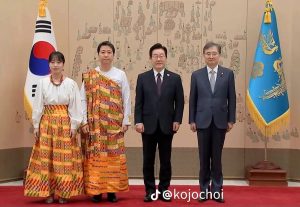 There are few, if any, clearly documented modern precedents of a naturalised citizen being appointed as ambassador by one sovereign state to the individual’s country of birth. In that sense, Ghana’s decision stands out as an unusual example of cross-national diplomatic trust.
Supporters of the appointment view it as an affirmation that citizenship is not solely inherited but can be earned through commitment, integration, and service. In a global system where Western countries routinely appoint naturalised citizens of African and Asian origin to high office, Ghana’s decision is seen as an assertion that reciprocity and inclusion should not operate in only one direction.
At the same time, the appointment has prompted broader debate across Africa about identity, loyalty, and national interest – debates that many societies confront quietly but rarely articulate publicly. Ghana’s choice does not end that conversation; it brings it into the open.
 Ultimately, this appointment is less about one individual and more about how African states define citizenship in an interconnected world. Whether others follow Ghana’s example or chart a different course, the decision has already achieved something significant: it has forced a serious continental conversation about belonging, trust, and the meaning of national identity in the twenty-first century
—————————————————————————————————————————————
Your help to our media platform will support the delivery of the independent journalism and broadcast the world needs. Support us by making any contribution. Your donation and support allows us to be completely focus, deeply investigative and independent. It also affords us the opportunity to produce more programmes online which is a platform universally utilised.
Thank you.
Please click link to make – DONATION