

By ifeoma Onyekachi
A coalition of opposition leaders under the platform of the African Democratic Congress (ADC) on Wednesday escalated political tensions ahead of the 2027 elections, staging a mass protest at the headquarters of the Independent National Electoral Commission (INEC) in Abuja and issuing a six-point demand aimed at safeguarding Nigeria’s democracy.
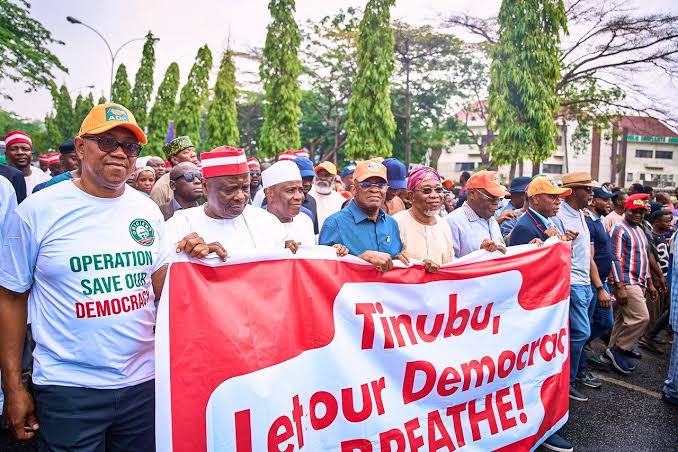
The protest, tagged #OccupyINEC, transformed into a rare show of opposition unity, drawing an unprecedented convergence of political heavyweights cutting across party lines.
Among those present were former Senate President David Mark, former Vice President Atiku Abubakar, Labour Party’s 2023 presidential candidate Peter Obi, former Kano State governor Rabiu Kwankwaso, former Osun governor Rauf Aregbesola, ex-Rivers governor Rotimi Amaechi, and former Kogi West senator Dino Melaye.
Hundreds of supporters, including members of the Kwankwasiyya Movement, civil society actors, and youth groups, flooded the Maitama axis despite rainfall, signaling what analysts describe as early coalition-building ahead of 2027.
What Triggered the Protest
At the heart of the protest is INEC’s controversial decision to refuse official correspondence from rival factions of the ADC, following a Court of Appeal ruling on the party’s lingering leadership crisis.
The commission’s stance effectively freezing recognition of both factions led by David Mark and Nafiu Bala Gombe has been widely interpreted by opposition figures as an overreach into party autonomy.
Political observers note that similar disputes in other parties have historically been resolved internally or through the courts, making INEC’s posture in this instance particularly contentious.
ADC’s 6-Point Demands (Expanded)
Although organisers did not initially release a formal document on-site, multiple sources indicate the protest centered on six core demands:
Immediate recognition of legitimate party leadership in line with judicial pronouncements
Non-interference by INEC in internal party affairs
Commitment to transparent and impartial electoral processes ahead of 2027
Clear guidelines on party correspondence and recognition protocols
Safeguards against the emergence of a one-party state
Institutional accountability and respect for democratic norms
These demands, according to insiders, are expected to be formally submitted to INEC leadership and possibly escalated through legal and legislative channels.
“Democracy Must Not Be Killed” Obi
Addressing protesters, Peter Obi framed the demonstration as a national call to action, not just a party grievance.
“We say no to a one-party system. Nigerians must rise to defend democracy, unity, and the future of this country,” he declared.
His remarks echoed growing concerns among opposition blocs that Nigeria’s political space is shrinking, with fears of dominance by a single ruling structure ahead of the next general elections.
Amaechi, Others Attack Government Policies
Rotimi Amaechi used the platform to deliver a scathing critique of the current administration, linking economic hardship to governance failures.
He referenced controversial policy decisions, including the reinstatement of Nigeria’s old national anthem by President Bola Tinubu in 2024, arguing that symbolic changes have not translated into improved living conditions.
“They promised roads, prosperity what Nigerians see today is hardship,” he said.
Symbolism and Public Sentiment
In a striking moment, protesters sang Nigeria’s former anthem, “Arise, O Compatriots,” despite its official replacement. Analysts interpret this as symbolic resistance and nostalgia for perceived democratic ideals of the past.
Placards reading “In David Mark’s NWC We Trust” and “Save Our Democracy” underscored both internal party loyalty and broader institutional concerns.
Grassroots Mobilisation and Wider Coalition
Yunusa Tanko, National Coordinator of the Obidient Movement, described the protest as part of a larger mobilisation strategy.
He accused INEC of acting as “judge, accuser, and defender,” warning that public frustration is deepening.
What began as an ADC-focused protest quickly evolved into a multi-party coalition rally, with participants traveling from different states highlighting a rare alignment among historically fragmented opposition forces.
Security Presence, Peaceful Conduct
Security operatives maintained a visible but restrained presence around the INEC complex. Despite the large turnout and charged rhetoric, the protest remained peaceful, with no major incidents reported.
Political Implications
The demonstration signals three critical developments:
Early opposition realignment ahead of 2027
Growing distrust in electoral institutions
Potential legal and constitutional battles over party regulation
Analysts say if sustained, the OccupyINEC movement could evolve into a broader pro-democracy campaign, reshaping Nigeria’s political landscape in the coming months.
Bottom Line
What started as a dispute over ADC leadership has escalated into a national conversation about electoral integrity, institutional neutrality, and the future of Nigeria’s democracy.
The coming weeks will be crucial in determining whether INEC responds with policy clarification or whether the confrontation deepens into a full-scale political crisis.
—————————————————————————————————————————————
Your help to our media platform will support the delivery of the independent journalism and broadcast the world needs. Support us by making any contribution. Your donation and support allows us to be completely focus, deeply investigative and independent. It also affords us the opportunity to produce more programmes online which is a platform universally utilised.
Thank you.
Please click link to make – DONATION