

As the Independent National Electoral Commission, INEC, closes the Continuous Voter Registration exercise and the nationwide claims and objections window, Nigeria’s political parties are entering a new and potentially decisive phase of the 2027 general election.
The deadline marks more than the end of an administrative exercise. It effectively closes one of the most important avenues through which Nigerians can position themselves to participate in the next presidential election, while giving political parties a clearer picture of the electorate they must persuade, mobilise and ultimately bring to the polling units.
The question now is no longer simply how many Nigerians registered.
It is how many will collect their Permanent Voter Cards, turn up on election day and determine who controls Nigeria from 2027.
The stakes are particularly high after the record-low turnout of the 2023 presidential election, when fewer than three in 10 registered voters cast their ballots.
This time, civil society organisations, labour unions, pro-democracy groups and political movements have mounted sustained campaigns to persuade Nigerians, particularly young people, to register and participate.
Their efforts have produced a new electoral dynamic in which voter mobilisation could become as important as campaign spending, party structures and political endorsements.
For the major parties, therefore, the closing of the registration window marks the beginning of another battle: converting registration figures into actual votes.
Kano, Lagos emerge as critical battlegrounds
The geographical distribution of new registrations is already providing clues about where the battle for 2027 could be fiercest.
Kano recorded the highest number of completed registrations, with 330,906 new voters, representing 8.55 per cent of the national total. Lagos followed with 181,254, while Delta recorded 166,895. Edo had 156,150 and Ebonyi 146,507.
But the strategic importance of the figures goes beyond the number of new registrants.
Lagos remains Nigeria’s largest voter bloc, with more than seven million registered voters, while Kano has about 5.92 million.
The two states sit at the heart of two of the country’s most politically influential regions — the South-West and North-West — making them critical targets for every serious presidential campaign.
Under Section 134 of the Constitution, winning the presidency requires more than securing the highest number of votes nationwide. A candidate must also obtain at least 25 per cent of the votes cast in two-thirds of the states and the Federal Capital Territory.
That constitutional requirement makes broad geographical support indispensable.
For the APC, maintaining its South-West advantage while rebuilding or consolidating its northern base will be critical.
For the opposition, the challenge is to break the ruling party’s traditional strongholds and build a coalition capable of delivering votes across regions.
The new registration figures suggest that neither side can afford to take any major voter population for granted.
APC: Defend the base, sell the reforms
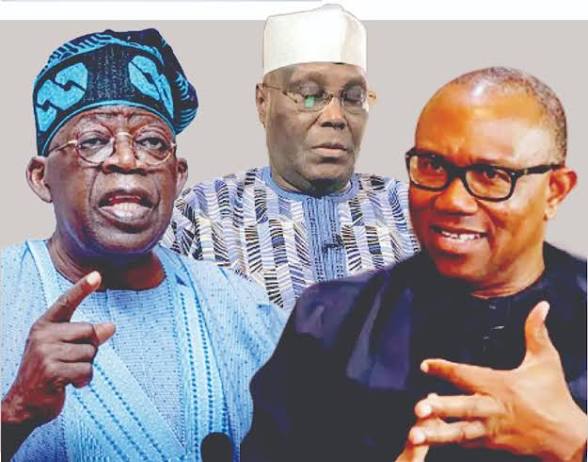
For President Bola Tinubu and the ruling All Progressives Congress, the immediate challenge is to translate the administration’s economic reform narrative into electoral support.
The party enters the race with significant structural advantages, including control of the federal government, a large number of state governments and an established political network.
But the APC also faces the political consequences of the economic hardship that accompanied some of the administration’s reforms.
Chief Henry Ajomale, a close associate of President Tinubu and former chairman of the Lagos State APC, believes the ruling party can overcome the opposition challenge.
Ajomale dismissed the prospect of a repeat of the political dynamics of 2023, arguing that voters are now more aware of the administration’s policies and that the opposition lacks the cohesion required to defeat the president.
He also pointed to what he described as security improvements in parts of the North and the support of more than 31 governors for Tinubu as evidence of the president’s political strength.
According to him, the economic difficulties confronting Nigerians should be viewed against the background of the structural problems inherited by the administration.
He argued that voters would ultimately reward the government if the reforms begin to deliver sustained economic growth.
Ajomale also predicted a higher turnout in 2027, saying improved security would encourage more Nigerians to return to the polling units.
But the APC’s challenge remains substantial.
High registration figures do not automatically translate into votes for the ruling party. Indeed, the larger and younger the electorate becomes, the greater the need for the APC to convince voters that its economic policies are producing tangible improvements in their daily lives.
Lagos, despite being a traditional APC stronghold, cannot therefore be treated as an automatic electoral bank.
ADC: Turn hardship into electoral anger
For opposition parties, the same registration figures tell a very different story.
The African Democratic Congress, ADC, believes economic hardship could drive millions of previously apathetic Nigerians to the ballot box.
Tunji Shelle, an ADC chieftain in Lagos, argued that the cost-of-living crisis has created widespread dissatisfaction that could translate into higher turnout.
He maintained that Nigerians struggling with food, transportation and other basic necessities have stronger incentives to participate in the 2027 election and demand accountability.
Shelle also expressed concern about the integrity of the final voters’ register, stressing that opposition parties would need a transparent electoral process to convert public dissatisfaction into votes.
He claimed that his own informal survey suggested strong opposition to the incumbent administration, although such a survey is not an independent measure of national voter sentiment.
For the ADC, therefore, the challenge is clear: turn anger into organisation.
That means building structures at ward and polling-unit levels, mobilising new voters, protecting votes and ensuring that dissatisfaction does not once again translate into voter apathy.
NDC: Can Obi-Kwankwaso mobilisation break the apathy cycle?
The Nigeria Democratic Congress, NDC, faces perhaps a different challenge.
With Peter Obi’s support base and Rabiu Kwankwaso’s political machinery forming the foundation of its joint ticket, the party’s biggest task is translating personality-driven support into a nationwide party structure.
Tanko Yunusa, National Coordinator of the Obidient Movement, said the NDC was targeting turnout of about 60 per cent of registered voters.
He said the party had begun nationwide mobilisation to introduce voters to its platform, logo and symbol, particularly because it is a relatively new political vehicle.
For the NDC, voter education will be as important as voter mobilisation.
Supporters who know Peter Obi but are unfamiliar with the party’s identity must be persuaded to identify the NDC on the ballot and vote accordingly.
The party also faces the challenge of building a structure capable of protecting votes beyond social media enthusiasm.
Yunusa called for greater vigilance by security agencies, warning that intimidation and electoral violence could discourage voters from exercising their rights.
The NDC’s ability to combine Obi’s national appeal with Kwankwaso’s influence in the North could make it a significant player, but its success will ultimately depend on whether the alliance can translate its political following into actual votes across enough states.
The youth factor
Perhaps the biggest uncertainty ahead of 2027 is the behaviour of young voters.
Available registration data indicate a strong participation by Nigerians aged between 18 and 34.
That development could force political parties to rethink traditional campaign strategies.
The new electorate is more likely to demand answers on employment, inflation, education, technology, insecurity and economic opportunity than simply respond to traditional political patronage.
It is also more connected to social media, where political narratives can spread rapidly and where candidates can be challenged directly by voters.
The implication is significant.
Campaigns built exclusively around rallies, political endorsements and party machinery may no longer be sufficient.
Candidates will increasingly have to convince voters that their policies can improve their lives.
Registration is only the first battle
But there is a major caveat to the optimism surrounding the new figures.
Registration is not voting.
A voter who registers but fails to collect the necessary voting document, or collects it but does not appear at the polling unit, does not contribute to the final result.
That is why civic organisations are already shifting their attention from registration to mobilisation.
Chekwas Okorie, Convener of the Igbo Agenda Dialogue, believes the country can achieve a substantially higher turnout in 2027 if the current mobilisation is sustained.
He argued that low turnout makes elections more vulnerable to vote-buying because political actors have to persuade or influence a much smaller pool of voters.
According to Okorie, the South-East offers a clear example of the consequences of apathy.
He recalled that of about 11.5 million registered voters in the region in 2023, only about 2.2 million voted in the presidential election.
He said his organisation was established partly to persuade young Nigerians who had withdrawn from the political process to register, vote and participate.
Okorie also pointed to the recent Osun governorship election, where turnout was significantly higher than the national figure recorded in 2023, as evidence that stronger mobilisation can change electoral participation.
He urged INEC to make information about uncollected voter cards more accessible so that civic organisations and other stakeholders can help voters resolve collection problems before election day.
Technology brings opportunity — and risk
INEC’s increasing reliance on technology also remains under scrutiny.
Online registration has expanded access, but technical difficulties have frustrated some users.
The commission has also had to warn Nigerians about fraudulent websites and social media platforms purporting to offer voter registration services.
The credibility of the 2027 process will therefore depend not only on the number of people registered but also on the integrity of the technology supporting the voters’ register.
INEC will face pressure to demonstrate that the final register is accurate, transparent and free of fictitious or duplicate entries.
The commission must also ensure that voters can obtain their cards without unnecessary delays or bureaucratic obstacles.
The real battle begins now
With voter registration closing, the political parties can no longer hide behind promises of future mobilisation.
The numbers are beginning to emerge.
The political map is becoming clearer.
And the race is moving towards the much harder task of converting registered citizens into voters.
For the APC, the mission is to defend its traditional strongholds, convince voters that Tinubu’s reforms are delivering results and prevent economic frustration from becoming an anti-incumbency wave.
For the ADC and other opposition forces, the challenge is to transform public dissatisfaction into a disciplined nationwide electoral machine.
For the NDC, the test will be whether the Obi-Kwankwaso alliance can convert its popular appeal into a functioning structure capable of competing across Nigeria’s complex political geography.
And for INEC and the security agencies, the responsibility is to ensure that Nigerians who register can actually vote freely, safely and without intimidation.
The 2027 election may therefore not be decided simply by who has the largest political machinery or the deepest war chest.
It could be decided by something far more basic:
who succeeds in getting Nigerians off the sidelines and into the polling units.
The registration portal may be closing, but the real electoral contest is only beginning.
—————————————————————————————————————————————
Your help to our media platform will support the delivery of the independent journalism and broadcast the world needs. Support us by making any contribution. Your donation and support allows us to be completely focus, deeply investigative and independent. It also affords us the opportunity to produce more programmes online which is a platform universally utilised.
Thank you.
Please click link to make – DONATION