


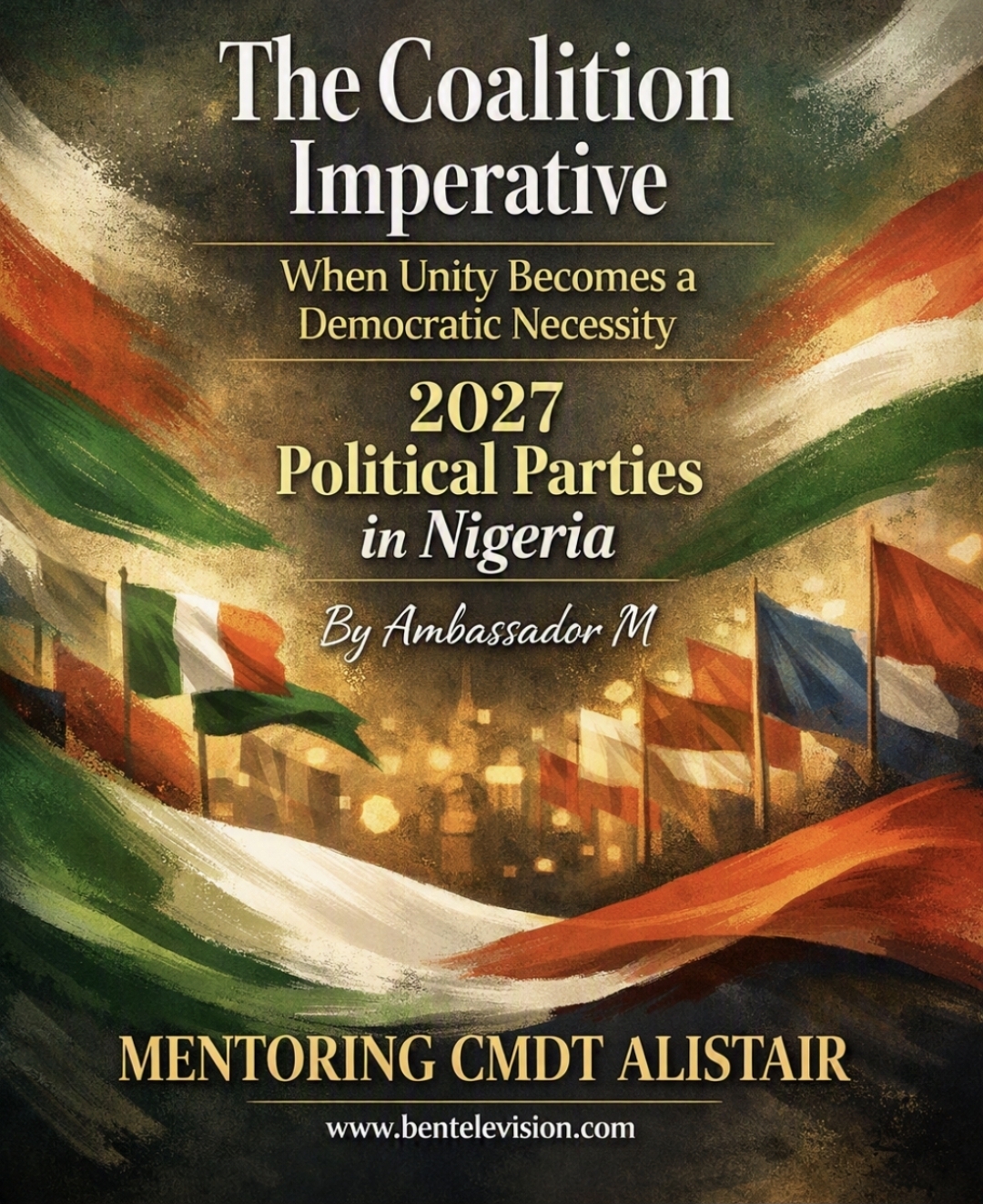
Nigeria is already entering the political theatre of 2027, and the opposition landscape is becoming as consequential as the contest itself. Across the African Democratic Congress (ADC), Nigeria Democratic Congress (NDC), Social Democratic Party (SDP), Labour Party (LP), Allied Peoples Movement (APM), PDP and other political platforms, realignments, defections and coalition discussions are reshaping the battlefield.
Yet the opposition faces a familiar Nigerian dilemma: can different parties and powerful political personalities unite around a national purpose, or will individual ambition, regional calculations and the struggle for the presidential ticket once again divide the votes for change?
The challenge is not simply defeating the ruling party. It is building a credible alternative capable of winning public confidence — and governing afterwards.

The Coalition Imperative — When Unity Becomes a Democratic Necessity
By Ambassador M. J. Abuba
2027: Can Nigeria’s Opposition Put Ambition Aside for the Nation?
The Coalition Imperative — When Unity Becomes a Democratic Necessity
By Ambassador M. J. Abubakar-Waziri | The Ambassador’s Desk
Nigeria is already entering the political theatre of 2027, and the opposition landscape is becoming as consequential as the contest itself. Across the African Democratic Congress (ADC), Nigeria Democratic Congress (NDC), Social Democratic Party (SDP), Labour Party (LP), Allied Peoples Movement (APM), PDP and other political platforms, realignments, defections and coalition discussions are reshaping the battlefield.
Yet the opposition faces a familiar Nigerian dilemma: can different parties and powerful political personalities unite around a national purpose, or will individual ambition, regional calculations and the struggle for the presidential ticket once again divide the votes for change?
The challenge is not simply defeating the ruling party. It is building a credible alternative capable of winning public confidence — and governing afterwards.
It is against this increasingly important backdrop that Ambassador M. J. Abubakar-Waziri, in this edition of The Ambassador’s Desk, examines the emerging opposition coalition and the Group of 100 initiative. His central warning is both simple and profound: the greatest threat to the opposition may ultimately come not from the ruling party, but from within its own ranks.
2027: The Coalition Imperative — When Unity Becomes a Democratic Necessity
Nigeria is approaching another consequential political season, and the atmosphere is already charged. Beyond the usual manoeuvring that precedes elections, there is a deeper concern that should engage every democrat: whether our political system continues to provide sufficient room for genuine competition, credible opposition and meaningful electoral choice.
Democracy cannot thrive on elections alone. Its vitality depends on plurality — the existence of alternative voices, viable political parties, independent institutions and the realistic possibility that those entrusted with power today can be peacefully replaced tomorrow.
It is against this background that the efforts of the Group of 100 to encourage Nigeria’s opposition parties and political tendencies to come together around a broad coalition deserve serious attention.
Whatever reservations anyone may have about the personalities involved, the principle behind the initiative is difficult to fault.
A fragmented opposition confronting a well-organised incumbent political establishment enters the contest at an obvious disadvantage. Where several opposition candidates divide essentially the same constituency for change, they may succeed only in weakening one another.
The arithmetic is simple: a divided opposition makes the incumbent stronger without the incumbent necessarily becoming more popular.
This is why the coalition project should not merely be viewed as an arrangement for politicians seeking office. Properly conceived, it could become an important democratic undertaking aimed at restoring competitiveness to Nigeria’s political system.
But therein also lies the danger.
The Enemy Within
The greatest threat to the proposed coalition may ultimately not come from the ruling party.
It may come from within the opposition itself.
Personal ambition, ego, mistrust, regional calculations and the perennial struggle over who becomes presidential candidate, running mate, party chairman or beneficiary of political appointments could destroy the project before Nigerians are given an opportunity to judge it.
Nigeria has travelled this road before.
Political alliances are often enthusiastically announced amid handshakes, photographs and declarations of patriotism. Difficulties begin when discussions move from principles to positions.
Everyone supports sacrifice until it is his ambition that must be sacrificed.
That is precisely where the Group of 100 and the opposition leadership must demonstrate that this initiative is different.
If every political leader enters the coalition convinced that he alone must be its presidential candidate, there is, in reality, no coalition. There is merely a temporary gathering of competing presidential ambitions.
Someone must be prepared to step aside.
Someone must accept that personal aspiration, however legitimate, cannot always supersede collective purpose.
And everyone involved must understand that compromise is not surrender. It is frequently the price of political progress.
Build a Coalition of Purpose, Not Convenience
The opposition must also avoid reducing the project to a simple arithmetic of personalities.
Nigeria does not merely need several political parties joining together to defeat another political party. That would be an alliance of convenience, and alliances built solely around removing an incumbent often struggle to govern effectively afterwards.
The coalition must answer a more important question:
What exactly will it do differently?
It should articulate a credible national programme addressing insecurity, unemployment, poverty, economic hardship, education, healthcare, institutional reform and national cohesion.
Nigerians deserve more than a coalition against somebody. They deserve a coalition for something.
That distinction is fundamental.
The process of selecting candidates must equally command public confidence. Consensus should be pursued wherever possible; where consensus becomes impossible, transparent and mutually accepted procedures should determine the outcome.
No aspirant should be allowed to hold the entire coalition hostage.
Those who lose must be prepared to support those who emerge. Those who emerge must equally resist the temptation to humiliate or marginalise those who stepped aside.
Trust must replace suspicion.
Institutions Must Be Above Politics
There are also growing concerns among Nigerians about the independence and resilience of institutions central to the democratic process. Such concerns, whether directed at electoral administration, law enforcement or the adjudication of electoral disputes, should never simply be dismissed as partisan complaints.
Institutions earn public confidence not merely by asserting their independence but by demonstrating it.
The responsibility therefore extends beyond the opposition. The government of the day has a historic obligation to ensure that the political environment remains open and competitive and that institutions charged with administering and adjudicating elections are allowed to discharge their responsibilities without improper interference.
A confident government should not fear political competition.
A confident ruling party should defeat its opponents at the ballot box, not seek their disappearance from the political landscape.
Equally, opposition parties must strengthen their internal democracy, organise effectively at the grassroots, protect their votes lawfully and offer Nigerians an alternative sufficiently compelling to earn their confidence.
A Moment Bigger Than Individual Ambition
The Group of 100 initiative therefore deserves encouragement, but encouragement must come with caution.
The coalition must not become another gathering of political grandees negotiating positions behind closed doors while invoking the Nigerian people merely as spectators.
Civil society, young Nigerians, women, professionals, organised labour, business, academia and other constituencies should have meaningful representation in shaping its programme.
If this coalition is to claim that it represents an alternative future, Nigerians themselves must recognise their aspirations within it.
Most importantly, those leading the initiative must remember that history sometimes presents political actors with moments requiring them to choose between personal ambition and national purpose.
This may be one of those moments.
The ruling party will naturally fight to retain power. That is politics. The opposition’s responsibility is to organise itself sufficiently to provide Nigerians with a credible alternative.
There is nothing inherently undemocratic about an incumbent seeking another mandate. What becomes dangerous for democracy is when political competition ceases to be meaningful or when citizens begin to believe that changing a government through the ballot box has become practically impossible.
That is why a viable opposition is not merely important to opposition politicians.
It is important to Nigeria.
The Group of 100 must therefore keep its eyes firmly on the larger objective. Personalities will come and go. Presidential ambitions will rise and fall. Political parties themselves may change names and configurations.
But Nigeria’s democracy must endure.
If the opposition believes that 2027 represents a defining moment, then its leaders must demonstrate that belief through sacrifice, discipline and compromise.
The road ahead will not be easy. There will be disagreements. There will be provocations. There will almost certainly be attempts — from within and outside — to exploit differences among coalition partners.
The answer must be patience, dialogue and an unwavering commitment to the common objective.
For the opposition, the lesson could hardly be clearer:
No individual ambition should be greater than the coalition, and no coalition should be greater than Nigeria.
The train towards 2027 is already moving. Those who genuinely desire political change must decide whether they will board it together or remain on the platform arguing over who deserves the best seat.
Because when history finally arrives at the station, it will not ask who had the greatest ambition.
It will ask who had the wisdom to put ambition aside.
— Ambassador M. J. Abubakar-Waziri
The Ambassador’s Desk
The Coalition Imperative — When Unity Becomes a Democratic Necessity
By Ambassador M. J. Abuba
2027: Can Nigeria’s Opposition Put Ambition Aside for the Nation?
The Coalition Imperative — When Unity Becomes a Democratic Necessity
By Ambassador M. J. Abubakar-Waziri | The Ambassador’s Desk
Nigeria is already entering the political theatre of 2027, and the opposition landscape is becoming as consequential as the contest itself. Across the African Democratic Congress (ADC), Nigeria Democratic Congress (NDC), Social Democratic Party (SDP), Labour Party (LP), Allied Peoples Movement (APM), PDP and other political platforms, realignments, defections and coalition discussions are reshaping the battlefield.
Yet the opposition faces a familiar Nigerian dilemma: can different parties and powerful political personalities unite around a national purpose, or will individual ambition, regional calculations and the struggle for the presidential ticket once again divide the votes for change?
The challenge is not simply defeating the ruling party. It is building a credible alternative capable of winning public confidence — and governing afterwards.
It is against this increasingly important backdrop that Ambassador M. J. Abubakar-Waziri, in this edition of The Ambassador’s Desk, examines the emerging opposition coalition and the Group of 100 initiative. His central warning is both simple and profound: the greatest threat to the opposition may ultimately come not from the ruling party, but from within its own ranks.
2027: The Coalition Imperative — When Unity Becomes a Democratic Necessity
Nigeria is approaching another consequential political season, and the atmosphere is already charged. Beyond the usual manoeuvring that precedes elections, there is a deeper concern that should engage every democrat: whether our political system continues to provide sufficient room for genuine competition, credible opposition and meaningful electoral choice.
Democracy cannot thrive on elections alone. Its vitality depends on plurality — the existence of alternative voices, viable political parties, independent institutions and the realistic possibility that those entrusted with power today can be peacefully replaced tomorrow.
It is against this background that the efforts of the Group of 100 to encourage Nigeria’s opposition parties and political tendencies to come together around a broad coalition deserve serious attention.
Whatever reservations anyone may have about the personalities involved, the principle behind the initiative is difficult to fault.
A fragmented opposition confronting a well-organised incumbent political establishment enters the contest at an obvious disadvantage. Where several opposition candidates divide essentially the same constituency for change, they may succeed only in weakening one another.
The arithmetic is simple: a divided opposition makes the incumbent stronger without the incumbent necessarily becoming more popular.
This is why the coalition project should not merely be viewed as an arrangement for politicians seeking office. Properly conceived, it could become an important democratic undertaking aimed at restoring competitiveness to Nigeria’s political system.
But therein also lies the danger.
The Enemy Within
The greatest threat to the proposed coalition may ultimately not come from the ruling party.
It may come from within the opposition itself.
Personal ambition, ego, mistrust, regional calculations and the perennial struggle over who becomes presidential candidate, running mate, party chairman or beneficiary of political appointments could destroy the project before Nigerians are given an opportunity to judge it.
Nigeria has travelled this road before.
Political alliances are often enthusiastically announced amid handshakes, photographs and declarations of patriotism. Difficulties begin when discussions move from principles to positions.
Everyone supports sacrifice until it is his ambition that must be sacrificed.
That is precisely where the Group of 100 and the opposition leadership must demonstrate that this initiative is different.
If every political leader enters the coalition convinced that he alone must be its presidential candidate, there is, in reality, no coalition. There is merely a temporary gathering of competing presidential ambitions.
Someone must be prepared to step aside.
Someone must accept that personal aspiration, however legitimate, cannot always supersede collective purpose.
And everyone involved must understand that compromise is not surrender. It is frequently the price of political progress.
Build a Coalition of Purpose, Not Convenience
The opposition must also avoid reducing the project to a simple arithmetic of personalities.
Nigeria does not merely need several political parties joining together to defeat another political party. That would be an alliance of convenience, and alliances built solely around removing an incumbent often struggle to govern effectively afterwards.
The coalition must answer a more important question:
What exactly will it do differently?
It should articulate a credible national programme addressing insecurity, unemployment, poverty, economic hardship, education, healthcare, institutional reform and national cohesion.
Nigerians deserve more than a coalition against somebody. They deserve a coalition for something.
That distinction is fundamental.
The process of selecting candidates must equally command public confidence. Consensus should be pursued wherever possible; where consensus becomes impossible, transparent and mutually accepted procedures should determine the outcome.
No aspirant should be allowed to hold the entire coalition hostage.
Those who lose must be prepared to support those who emerge. Those who emerge must equally resist the temptation to humiliate or marginalise those who stepped aside.
Trust must replace suspicion.
Institutions Must Be Above Politics
There are also growing concerns among Nigerians about the independence and resilience of institutions central to the democratic process. Such concerns, whether directed at electoral administration, law enforcement or the adjudication of electoral disputes, should never simply be dismissed as partisan complaints.
Institutions earn public confidence not merely by asserting their independence but by demonstrating it.
The responsibility therefore extends beyond the opposition. The government of the day has a historic obligation to ensure that the political environment remains open and competitive and that institutions charged with administering and adjudicating elections are allowed to discharge their responsibilities without improper interference.
A confident government should not fear political competition.
A confident ruling party should defeat its opponents at the ballot box, not seek their disappearance from the political landscape.
Equally, opposition parties must strengthen their internal democracy, organise effectively at the grassroots, protect their votes lawfully and offer Nigerians an alternative sufficiently compelling to earn their confidence.
A Moment Bigger Than Individual Ambition
The Group of 100 initiative therefore deserves encouragement, but encouragement must come with caution.
The coalition must not become another gathering of political grandees negotiating positions behind closed doors while invoking the Nigerian people merely as spectators.
Civil society, young Nigerians, women, professionals, organised labour, business, academia and other constituencies should have meaningful representation in shaping its programme.
If this coalition is to claim that it represents an alternative future, Nigerians themselves must recognise their aspirations within it.
Most importantly, those leading the initiative must remember that history sometimes presents political actors with moments requiring them to choose between personal ambition and national purpose.
This may be one of those moments.
The ruling party will naturally fight to retain power. That is politics. The opposition’s responsibility is to organise itself sufficiently to provide Nigerians with a credible alternative.
There is nothing inherently undemocratic about an incumbent seeking another mandate. What becomes dangerous for democracy is when political competition ceases to be meaningful or when citizens begin to believe that changing a government through the ballot box has become practically impossible.
That is why a viable opposition is not merely important to opposition politicians.
It is important to Nigeria.
The Group of 100 must therefore keep its eyes firmly on the larger objective. Personalities will come and go. Presidential ambitions will rise and fall. Political parties themselves may change names and configurations.
But Nigeria’s democracy must endure.
If the opposition believes that 2027 represents a defining moment, then its leaders must demonstrate that belief through sacrifice, discipline and compromise.
The road ahead will not be easy. There will be disagreements. There will be provocations. There will almost certainly be attempts — from within and outside — to exploit differences among coalition partners.
The answer must be patience, dialogue and an unwavering commitment to the common objective.
For the opposition, the lesson could hardly be clearer:
No individual ambition should be greater than the coalition, and no coalition should be greater than Nigeria.
The train towards 2027 is already moving. Those who genuinely desire political change must decide whether they will board it together or remain on the platform arguing over who deserves the best seat.
Because when history finally arrives at the station, it will not ask who had the greatest ambition.
It will ask who had the wisdom to put ambition aside.
— Ambassador M. J. Abubakar-Waziri
The Ambassador’s DeskIt is against this increasingly important backdrop that Ambassador M. J. Abubakar-Waziri, in this edition of The Ambassador’s Desk, examines the emerging opposition coalition and the Group of 100 initiative. His central warning is both simple and profound: the greatest threat to the opposition may ultimately come not from the ruling party, but from within its own ranks.
2027: The Message
Nigeria is approaching another consequential political season, and the atmosphere is already charged. Beyond the usual manoeuvring that precedes elections, there is a deeper concern that should engage every democrat: whether our political system continues to provide sufficient room for genuine competition, credible opposition and meaningful electoral choice.
Democracy cannot thrive on elections alone. Its vitality depends on plurality — the existence of alternative voices, viable political parties, independent institutions and the realistic possibility that those entrusted with power today can be peacefully replaced tomorrow.
It is against this background that the efforts of the Group of 100 to encourage Nigeria’s opposition parties and political tendencies to come together around a broad coalition deserve serious attention.
Whatever reservations anyone may have about the personalities involved, the principle behind the initiative is difficult to fault.
A fragmented opposition confronting a well-organised incumbent political establishment enters the contest at an obvious disadvantage. Where several opposition candidates divide essentially the same constituency for change, they may succeed only in weakening one another.
The arithmetic is simple: a divided opposition makes the incumbent stronger without the incumbent necessarily becoming more popular.
This is why the coalition project should not merely be viewed as an arrangement for politicians seeking office. Properly conceived, it could become an important democratic undertaking aimed at restoring competitiveness to Nigeria’s political system.
But therein also lies the danger.
The Enemy Within
The greatest threat to the proposed coalition may ultimately not come from the ruling party.
It may come from within the opposition itself.
Personal ambition, ego, mistrust, regional calculations and the perennial struggle over who becomes presidential candidate, running mate, party chairman or beneficiary of political appointments could destroy the project before Nigerians are given an opportunity to judge it.
Nigeria has travelled this road before.
Political alliances are often enthusiastically announced amid handshakes, photographs and declarations of patriotism. Difficulties begin when discussions move from principles to positions.
Everyone supports sacrifice until it is his ambition that must be sacrificed.
That is precisely where the Group of 100 and the opposition leadership must demonstrate that this initiative is different.
If every political leader enters the coalition convinced that he alone must be its presidential candidate, there is, in reality, no coalition. There is merely a temporary gathering of competing presidential ambitions.
Someone must be prepared to step aside.
Someone must accept that personal aspiration, however legitimate, cannot always supersede collective purpose.
And everyone involved must understand that compromise is not surrender. It is frequently the price of political progress.
Build a Coalition of Purpose, Not Convenience
The opposition must also avoid reducing the project to a simple arithmetic of personalities.
Nigeria does not merely need several political parties joining together to defeat another political party. That would be an alliance of convenience, and alliances built solely around removing an incumbent often struggle to govern effectively afterwards.
The coalition must answer a more important question:
What exactly will it do differently?
It should articulate a credible national programme addressing insecurity, unemployment, poverty, economic hardship, education, healthcare, institutional reform and national cohesion.
Nigerians deserve more than a coalition against somebody. They deserve a coalition for something.
That distinction is fundamental.
The process of selecting candidates must equally command public confidence. Consensus should be pursued wherever possible; where consensus becomes impossible, transparent and mutually accepted procedures should determine the outcome.
No aspirant should be allowed to hold the entire coalition hostage.
Those who lose must be prepared to support those who emerge. Those who emerge must equally resist the temptation to humiliate or marginalise those who stepped aside.
Trust must replace suspicion.
Institutions Must Be Above Politics
There are also growing concerns among Nigerians about the independence and resilience of institutions central to the democratic process. Such concerns, whether directed at electoral administration, law enforcement or the adjudication of electoral disputes, should never simply be dismissed as partisan complaints.
Institutions earn public confidence not merely by asserting their independence but by demonstrating it.
The responsibility therefore extends beyond the opposition. The government of the day has a historic obligation to ensure that the political environment remains open and competitive and that institutions charged with administering and adjudicating elections are allowed to discharge their responsibilities without improper interference.
A confident government should not fear political competition.
A confident ruling party should defeat its opponents at the ballot box, not seek their disappearance from the political landscape.
Equally, opposition parties must strengthen their internal democracy, organise effectively at the grassroots, protect their votes lawfully and offer Nigerians an alternative sufficiently compelling to earn their confidence.
A Moment Bigger Than Individual Ambition
The Group of 100 initiative therefore deserves encouragement, but encouragement must come with caution.
The coalition must not become another gathering of political grandees negotiating positions behind closed doors while invoking the Nigerian people merely as spectators.
Civil society, young Nigerians, women, professionals, organised labour, business, academia and other constituencies should have meaningful representation in shaping its programme.
If this coalition is to claim that it represents an alternative future, Nigerians themselves must recognise their aspirations within it.
Most importantly, those leading the initiative must remember that history sometimes presents political actors with moments requiring them to choose between personal ambition and national purpose.
This may be one of those moments.
The ruling party will naturally fight to retain power. That is politics. The opposition’s responsibility is to organise itself sufficiently to provide Nigerians with a credible alternative.
There is nothing inherently undemocratic about an incumbent seeking another mandate. What becomes dangerous for democracy is when political competition ceases to be meaningful or when citizens begin to believe that changing a government through the ballot box has become practically impossible.
That is why a viable opposition is not merely important to opposition politicians.
It is important to Nigeria.
The Group of 100 must therefore keep its eyes firmly on the larger objective. Personalities will come and go. Presidential ambitions will rise and fall. Political parties themselves may change names and configurations.
But Nigeria’s democracy must endure.
If the opposition believes that 2027 represents a defining moment, then its leaders must demonstrate that belief through sacrifice, discipline and compromise.
The road ahead will not be easy. There will be disagreements. There will be provocations. There will almost certainly be attempts — from within and outside — to exploit differences among coalition partners.
The answer must be patience, dialogue and an unwavering commitment to the common objective.
For the opposition, the lesson could hardly be clearer:
No individual ambition should be greater than the coalition, and no coalition should be greater than Nigeria.
The train towards 2027 is already moving. Those who genuinely desire political change must decide whether they will board it together or remain on the platform arguing over who deserves the best seat.
Because when history finally arrives at the station, it will not ask who had the greatest ambition.
It will ask who had the wisdom to put ambition aside.
— Ambassador M. J. Abubakar-Waziri
The Ambassador’s Desk
—————————————————————————————————————————————
Your help to our media platform will support the delivery of the independent journalism and broadcast the world needs. Support us by making any contribution. Your donation and support allows us to be completely focus, deeply investigative and independent. It also affords us the opportunity to produce more programmes online which is a platform universally utilised.
Thank you.
Please click link to make – DONATION