


As governments confront rising food insecurity, youth unemployment and climate-related agricultural pressures, international development institutions are seeking stronger investment partnerships to transform rural economies into engines of sustainable growth.
For Africa and other developing regions, where millions depend on smallholder agriculture, improving access to finance, technology and markets could strengthen food production, expand entrepreneurship and create employment opportunities.
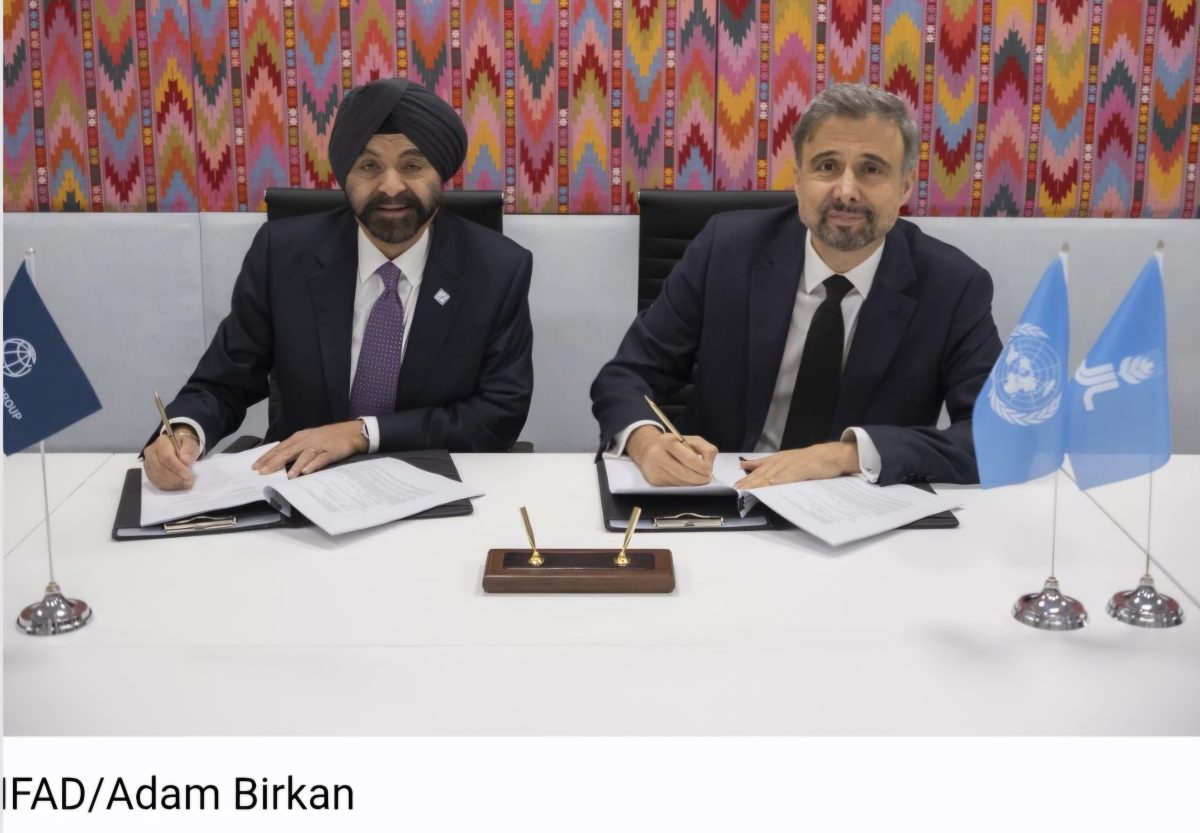
Against this backdrop, the World Bank Group and International Fund for Agricultural Development (IFAD) signed a new Co-Financing Framework Agreement in Bangkok, Thailand, on 13 October 2026, during the IMF and World Bank Annual Meetings.
The agreement seeks to accelerate joint investment in rural transformation, agricultural productivity, climate resilience and food systems.
“Together, the World Bank and IFAD bring the scale, reach and expertise to transform rural economies and agrifood systems,” said IFAD President Alvaro Lario.
He explained that the partnership would support greater investment, employment, resilience and food security for millions.
World Bank Group President Ajay Banga highlighted agriculture’s potential to generate opportunities for younger generations.
“The next generation needs opportunity, and agriculture can be a powerful source of jobs, growth, and food security,” Banga said.
The initiative builds on existing programmes, including AgriConnect, targeting agricultural transformation for 300 million smallholder farmers by 2030, and Water Forward, aiming to improve water security for one billion people.
Financial cooperation between IFAD and the World Bank’s International Development Association has expanded significantly, with co-financing increasing from approximately $646 million in 2021 to $1.56 billion in 2025.
A $70.5 million programme in Lesotho illustrates the partnership’s practical impact. According to IFAD, it has generated nearly 1,500 jobs, provided nutrition education to 217,000 people and supported more than 106,000 people in adopting climate-smart agricultural practices.
The new framework, initially covering five years, will streamline joint financing, procurement and project implementation while preserving both institutions’ independent accountability arrangements.
For African economies, including Nigeria, the partnership could provide opportunities to strengthen agricultural value chains, attract private investment, reduce rural poverty and improve food security.
Its wider significance will depend on how effectively international financing translates into productive farms, stronger rural businesses and sustainable livelihoods.
Source: IFAD Press Release No. 66/2026, 13 October 2026.
BEN Television | Bridging the Gap
www.bentelevision.com
—————————————————————————————————————————————
Your help to our media platform will support the delivery of the independent journalism and broadcast the world needs. Support us by making any contribution. Your donation and support allows us to be completely focus, deeply investigative and independent. It also affords us the opportunity to produce more programmes online which is a platform universally utilised.
Thank you.
Please click link to make – DONATION