


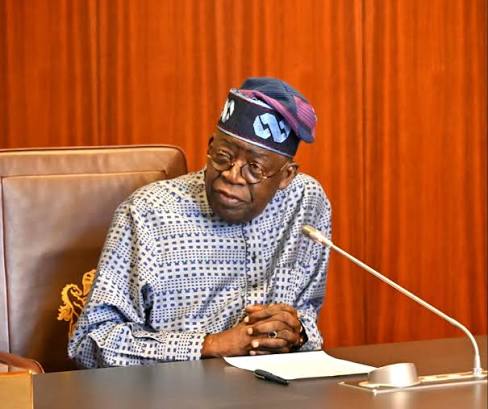
President Bola Ahmed Tinubu on Thursday reaffirmed his administration’s hardline position against negotiating with kidnappers, terrorists and other violent criminal groups, declaring that the federal government would neither pay ransom nor release detained suspects in exchange for abducted victims.
The President disclosed that kidnappers who abducted schoolchildren and teachers in communities in Oriire Local Government Area of Oyo State demanded money as well as the release of their imprisoned gang members, but the government rejected the conditions and instead pursued a rescue operation.
Tinubu made the disclosure while receiving traditional rulers from Oyo State, led by the Olubadan of Ibadanland, Oba Rashidi Ladoja, at the State House in Abuja.
“We refuse to negotiate with criminals. They wanted us to release members of their criminal gangs already in detention in addition to demanding money, but we said no deal. We will not negotiate with murderers and terrorists,” the President said.
The remarks come as the federal government intensifies efforts to tackle kidnapping, banditry and terrorism, which have remained among Nigeria’s most pressing security challenges despite years of military operations and security reforms.
Although successive administrations have maintained an official policy against paying ransom, criminal groups have continued to carry out mass abductions, particularly in schools, rural communities and along major highways. Security analysts have consistently warned that ransom payments fuel the cycle of violence by financing the acquisition of weapons and expanding the operational capacity of criminal networks.
Tinubu’s latest disclosure also highlights a disturbing shift in the tactics of kidnapping syndicates, with some groups now demanding the release of detained members alongside ransom payments—a strategy more commonly associated with terrorist organisations.
The President described the successful rescue of the abducted victims in Oyo State as evidence that Nigeria’s evolving security strategy was producing results.
He praised members of the Armed Forces and other security agencies for what he described as their professionalism and courage.
“I agree with you that we should commend the men and women of the Armed Forces for their excellent performance. Every security operation teaches us new lessons, challenges us to review our security architecture, strategy and operational plans, and strengthens our resolve to defeat terrorism and banditry,” he said.
As part of broader security reforms, Tinubu announced that the federal government was expanding the Nigerian Army from eight to 12 divisions to improve operational coverage and reduce response times to security threats across the country.
He said the administration was also strengthening local security structures by supporting the establishment of state police with constitutional safeguards to prevent abuse and enhancing the operational capacity of forest guards to flush out criminal elements from forests and other ungoverned spaces.
“There will be state police, but with guardrails against abuse. Traditional rulers will also have greater roles to play. We are equally enhancing the capacity of forest guards, not to chase animals, but to pursue criminals and deal decisively with them,” he said.
Tinubu stressed that intelligence gathering remains critical to the fight against insecurity and urged traditional rulers to mobilise their communities to identify suspicious movements and promptly share information with security agencies.
He linked Nigeria’s worsening security challenges partly to instability in the Sahel, noting that conflicts in Mali, Burkina Faso and the Niger Republic had intensified cross-border criminal activities.
According to the President, investigations into the Oriire kidnapping revealed that some of the perpetrators were foreign nationals, underscoring concerns about Nigeria’s porous borders and the growing influence of transnational criminal networks.
“We are enhancing the capacity of the forest guards. They will not only protect wildlife; they will pursue criminals in the forests. Intelligence is important, and I urge people to be vigilant, know their neighbourhoods and report strangers,” he said.
While acknowledging that security challenges remained significant, Tinubu expressed confidence that ongoing reforms were gradually improving the situation.
“The immediate challenge is monumental, but I asked for this responsibility and I accept both its assets and liabilities. I can assure Nigerians that the security situation is improving. Whenever you see our soldiers and police officers, encourage them and thank them because they are making tremendous sacrifices to keep our country safe,” he added.
The President also urged state governments to prioritise the construction of strategic road networks over non-essential infrastructure projects, arguing that improved roads would enhance security operations and improve access to vulnerable communities.
He noted that increased allocations to states had strengthened their fiscal position and challenged governors to channel more resources towards projects that directly improve security and economic development.
Tinubu further pledged to deepen engagement with traditional rulers, describing them as indispensable partners in intelligence gathering, conflict prevention and community security.
“I will continue to meet with traditional rulers across the country to listen to your counsel and receive your suggestions because you remain indispensable partners in safeguarding our communities,” he said.
Earlier, the Olubadan of Ibadanland, Oba Rashidi Ladoja, commended the federal government’s handling of the recent kidnappings in Oyo State, saying the refusal to pay ransom marked a significant shift in Nigeria’s response to abductions.
“We were apprehensive after that first major kidnapping in Oyo State, but between you and your security people, you have made a turning point. The fact that you did not pay ransom shows we now have a government that knows what it is doing,” the monarch said.
He also called for sustained security operations across the forest corridor linking Oyo, Niger and Kwara states, describing the areas around Iseyin, Igboho, Kishi and Baruten as particularly vulnerable to criminal activities if left unsecured.
Ladoja further praised the administration’s infrastructure programme in Oyo State, noting that ongoing federal projects valued at more than N2 trillion could significantly boost economic development and strengthen security across the state.
—————————————————————————————————————————————
Your help to our media platform will support the delivery of the independent journalism and broadcast the world needs. Support us by making any contribution. Your donation and support allows us to be completely focus, deeply investigative and independent. It also affords us the opportunity to produce more programmes online which is a platform universally utilised.
Thank you.
Please click link to make – DONATION