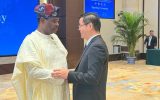


Vice President Kashim Shettima, Director-General of the World Trade Organisation (WTO), Dr. Ngozi Okonjo-Iweala, and other top government and business leaders have called on state governments to capitalise on Nigeria’s recent economic reforms by attracting investment, diversifying their economies and creating jobs.
The leaders spoke at the Delta State Economic and Investment Summit 2026 in Asaba, where they argued that the country’s next phase of economic growth would depend largely on the ability of states to convert improving macroeconomic conditions into broad-based prosperity.
Speaking at the summit themed “Harnessing Our Strengths, Unlocking Our Potentials,” Chairman of the Presidential Fiscal Policy and Tax Reforms Committee, Taiwo Oyedele, said while the Federal Government is responsible for maintaining macroeconomic stability, state and local governments must translate that stability into improved living standards.
“The centre secures economic stability, the state converts stability into shared prosperity, and local governments deliver it as the tangible highest standard of living for every family. That division of labour is where true fiscal restructuring takes place,” he said.
Oyedele said recent reforms by the Federal Government—including foreign exchange liberalisation, fuel subsidy removal, tighter monetary controls and tax reforms—had strengthened public finances and increased revenues accruing to states.
He noted that the reforms had enabled many states to pay salaries, settle pension obligations and expand investment in infrastructure and human capital.
Okonjo-Iweala urged Delta State and other sub-national governments to position themselves to benefit from the emerging era of global supply chain diversification, which she described as “re-globalisation.”
She said geopolitical tensions, tariff disputes and climate-related disruptions were prompting companies to spread production across more countries, creating new opportunities for African economies.
The WTO chief also identified the African Continental Free Trade Area (AfCFTA) as a major opportunity for states to attract investors seeking access to Africa’s 1.4 billion-person market.
“Seizing these opportunities should be at the heart of Delta State’s growth and development strategy,” she said.
She advised the state to focus on strategic sectors capable of driving industrialisation, employment and exports, identifying the blue economy as one area with significant potential.
“Delta can become Nigeria’s blue economy hub. Build fisheries, cold chain facilities, port services and marine logistics,” she said.
Vice President Shettima described Delta as one of Nigeria’s most promising investment destinations and assured that the Federal Government would continue supporting states implementing reforms aligned with President Bola Tinubu’s Renewed Hope Agenda.
He urged investors to take advantage of emerging opportunities in the state, citing its extensive coastline, seaports, gas reserves, agricultural potential and entrepreneurial population.
“The future of a people cannot be deposited in a single commodity. Diversification is an instinct of economic self-preservation and a measure of the quality of leadership,” he said.
Defending the Tinubu administration’s economic policies, Shettima said the reforms had strengthened Nigeria’s macroeconomic fundamentals despite global economic uncertainty.
He noted that the country’s foreign reserves had risen significantly, attributing the improvement to ongoing economic reforms.
Governor Sheriff Oborevwori used the summit to unveil a $100 million Investment Support Fund, designed to reduce investment risks, bridge financing gaps and attract private capital into Delta State.
He said the fund, which is not financed through borrowing, would help convert investment commitments into bankable projects capable of creating jobs and accelerating industrialisation.
“This is not a mere talk shop. The money is there as practical evidence of our commitment. We are matching words with action,” the governor said.
Business leaders also urged the state to build on its competitive advantages.
Chairman of the summit, Austin Avuru, called for greater investment in maritime infrastructure, agriculture and industrial development, while Chairman of Heirs Holdings, Tony Elumelu, pledged private-sector support for expanding electricity supply to drive industrial growth.
Anambra State Governor Chukwuma Soludo advocated stronger economic collaboration between Delta and Anambra, describing both states as natural partners capable of driving regional prosperity.
Renowned Kenyan scholar, Prof. Patrick Lumumba, challenged African governments to rely more on indigenous capital, technology and human resources, urging greater intra-African investment and the removal of barriers to regional economic integration.
—————————————————————————————————————————————
Your help to our media platform will support the delivery of the independent journalism and broadcast the world needs. Support us by making any contribution. Your donation and support allows us to be completely focus, deeply investigative and independent. It also affords us the opportunity to produce more programmes online which is a platform universally utilised.
Thank you.
Please click link to make – DONATION