


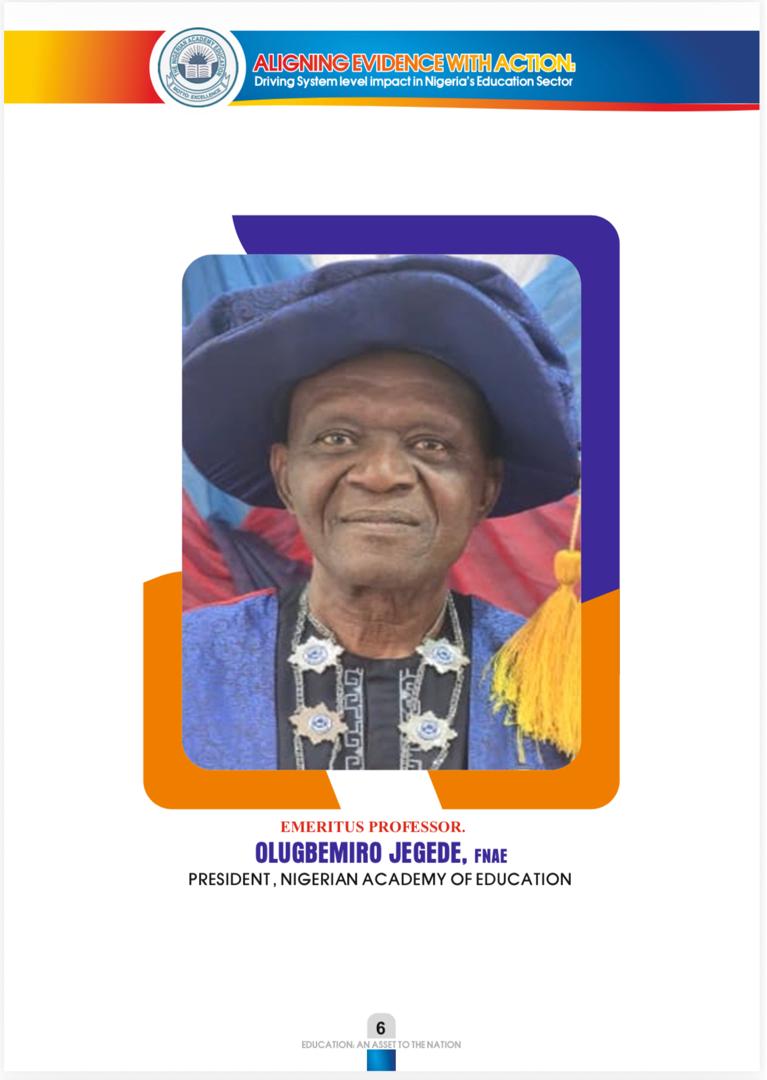
The Nigerian Academy of Education (NAE) has called on the Federal Government to urgently overhaul the country’s education system, including a comprehensive review of the National Policy on Education, restructuring of teacher training and the adoption of technology-driven classroom instruction.
The Academy warned that Nigeria risks falling behind in an increasingly technology-driven global economy unless it abandons outdated educational practices and embraces reforms that equip students and teachers with the skills required for the future.
President of the Academy, Emeritus Professor Olugbemiro Jegede, made the call at the opening of the NAE 2026 Annual Congress in Abuja, where he announced that the Federal Government had designated the Academy as the country’s apex national institution for digital literacy and the development of leaders for a future-ready economy.
The designation places the Academy at the centre of efforts to develop Nigeria’s national digital skills framework and provide intellectual direction for integrating Artificial Intelligence (AI), emerging technologies and innovative teaching methods into the education system.
Professor Jegede described the current state of the education sector as requiring urgent and fundamental intervention, insisting that gradual reforms would no longer be sufficient to address the challenges posed by changing technological and economic realities.
“Nigeria stands at a volatile crossroads where obsolete educational paradigms collide with an unforgiving 21st-century reality. The era of comfortable, incremental reforms is over,” he said.
He explained that the Academy would move beyond issuing policy recommendations to taking a more active role in shaping the country’s educational direction and addressing structural weaknesses within the sector.
The NAE President specifically urged the Federal Government to initiate an immediate review of the National Policy on Education, noting that the existing framework requires significant adjustments to reflect contemporary realities.
He also called for strict adherence to relevant laws and regulations guiding the composition of governing boards of educational institutions and government education agencies.
On teacher development, Jegede advocated a fundamental restructuring of teacher education and professional development programmes, alongside a comprehensive review of classroom instructional methods to improve learning outcomes.
He further stressed the need for policies that would guarantee equitable access to digital technologies in schools across the country, irrespective of geographical location, warning against a situation where technological advancement widens existing educational inequalities.
According to him, achieving meaningful transformation would require stronger collaboration among the Federal Ministry of Education, State Ministries of Education, the National and State Assemblies, educational parastatals and other relevant stakeholders.
He also challenged members and Fellows of the Academy to deploy their intellectual resources towards solving Nigeria’s educational challenges rather than limiting their contributions to academic discourse.
“The Academy has no room for sedentary scholars or armchair theoreticians. Nigeria requires your raw intellect and your immediate, unyielding involvement to reshape our pedagogical destiny,” he declared.
The Minister of Education, members of the National and State Assemblies, heads of educational agencies and other stakeholders attended the congress.
The event also featured the investiture of four distinguished academics as Fellows of the Nigerian Academy of Education.
Among those honoured was Professor Josiah Olusegun Ajiboye, First Vice-President of the Academy, in recognition of his contributions to educational scholarship and development.
The congress also remembered deceased members and relatives of Fellows, including Professor David Adamu Baikie, one of the founding members of the Academy, as well as the late Mrs Lassa and Mr Omotayo Olarinoye.
The Academy reaffirmed its commitment to advancing educational excellence and contributing to national development, stressing that its new national mandate would be judged by tangible contributions to policy reforms, digital literacy and the development of a globally competitive workforce.
—————————————————————————————————————————————
Your help to our media platform will support the delivery of the independent journalism and broadcast the world needs. Support us by making any contribution. Your donation and support allows us to be completely focus, deeply investigative and independent. It also affords us the opportunity to produce more programmes online which is a platform universally utilised.
Thank you.
Please click link to make – DONATION