

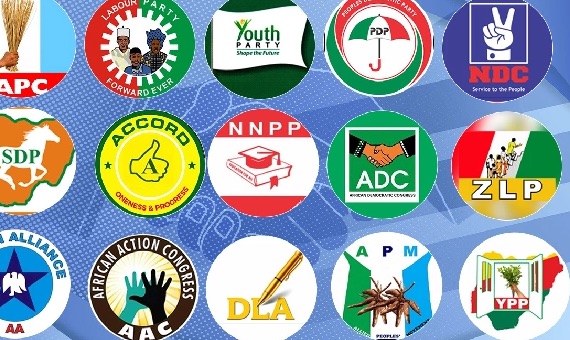
As campaigns for the 2027 general elections officially kick off across Nigeria, major opposition parties are facing mounting organisational challenges, with internal disputes, prolonged litigation and funding constraints threatening to slow their preparations for a nationwide contest against the ruling All Progressives Congress (APC).
While the APC has continued to expand its grassroots structures across the 36 states and the Federal Capital Territory (FCT), opposition parties are still battling leadership disputes, factional disagreements and efforts to reconcile aggrieved members.
The widening organisational gap has raised fresh questions over the ability of the opposition to build a coordinated nationwide campaign capable of challenging the ruling party as the 2027 race gathers momentum.
For the African Democratic Congress (ADC), resolving its internal crisis and ongoing legal battles appears to remain a priority before the party unveils a comprehensive campaign structure.
The leadership dispute has travelled through the courts from the Federal High Court to the Supreme Court, which recently set aside an order of the Court of Appeal and returned the matter to the trial court for accelerated hearing.
The suit was filed by an aggrieved party chieftain, Nafiu Bala Gombe, who challenged the leadership of former Senate President David Mark and National Secretary Rauf Aregbesola.
Despite the uncertainty surrounding its campaign structure, the ADC insists it is not under pressure to immediately launch its full campaign machinery.
The party’s National Publicity Secretary, Bolaji Abdullahi, dismissed concerns over the delay, saying the campaign period was long enough to accommodate the party’s preparations.
“We will release it when we are ready. The campaign is seven months long. It is not for two months,” Abdullahi told Daily Sun.
The position underscores the ADC’s strategy of prioritising internal consolidation before embarking on an aggressive nationwide campaign.
NDC battles internal disputes
The Nigeria Democratic Congress (NDC) is also working to overcome internal disagreements as it seeks to position itself as a major opposition platform ahead of the elections.
The party’s National Publicity Secretary, Osa Director, said efforts were ongoing to reconcile members and establish what he described as “unity of purpose and oneness.”
“We are doing our best to ensure unity of purpose and oneness so that we can focus on the task ahead. As an opposition party, we are willing to work with anyone who shares our vision,” Director said.
He said the party remained open to alliances with political parties and groups that shared its objectives.
However, disputes within some state chapters continue to pose challenges to the party’s efforts to build a cohesive national structure.
In Sokoto State, litigation over control of the party’s executive structure has suffered repeated adjournments and remains unresolved.
In Kaduna State, the state executive has accused the APC of sponsoring court cases allegedly aimed at frustrating its administrative reorganisation.
The Nasarawa chapter has also been embroiled in controversy following the suspension of its chairman over alleged anti-party activities.
Party insiders said the prolonged legal battles had diverted attention from the crucial task of building ward-level structures needed for effective grassroots mobilisation.
The NDC is also facing friction in Oyo State, where aggrieved members have petitioned the National Chairman, Senator Cleopas Moses Zuwoghe, alleging that the state leadership’s actions have worsened factionalism and mistrust within the chapter.
Copies of the petition were reportedly submitted to the South-West leadership and party leader, Senator Henry Seriake Dickson.
Funding challenge
Beyond leadership disputes and litigation, finances are emerging as another major obstacle for opposition parties.
Findings by Daily Sun indicate that fundraising efforts remain slow, with several state chapters yet to establish functional campaign accounts.
“We remain reliant on the goodwill of individual figures,” a party official said on condition of anonymity. “No coordinated national fundraising apparatus exists.”
The funding challenge could become more significant as campaigns intensify, with parties expected to finance rallies, media operations, grassroots mobilisation, transportation, polling-unit agents and other electoral activities across the country.
The situation contrasts sharply with the growing mobilisation within the APC.
The ruling party has continued to consolidate its campaign network, with its Renewed Hope Ambassadors initiative reportedly deploying more than 4.4 million canvassers across the 36 states and the FCT.
The APC has also conducted ward-level training and rallies in several states, including Anambra, Oyo, Akwa Ibom and Ondo, as it seeks to deepen its grassroots presence ahead of the election.
The contrast in preparedness is becoming increasingly important as the campaign season progresses.
While the APC is investing heavily in its grassroots machinery, opposition parties are still expending considerable political capital on leadership disputes, court cases, reconciliation and internal restructuring.
Race against time
For the opposition, the challenge is now twofold: resolve internal differences while simultaneously building the structures, funding networks and grassroots machinery required to compete against an increasingly organised ruling party.
Political alliances and public dissatisfaction with the government may provide the opposition with an opportunity, but converting that advantage into electoral success will require more than prominent politicians and campaign rhetoric.
The parties will need functional structures down to the wards and polling units, adequate funding, disciplined campaign teams and a unified political message capable of reaching voters across the country.
With the 2027 campaigns now underway, the coming months will determine whether the opposition can overcome its internal battles and turn its political alliances into a credible nationwide electoral machine—or remain divided while the APC consolidates its advantage.
—————————————————————————————————————————————
Your help to our media platform will support the delivery of the independent journalism and broadcast the world needs. Support us by making any contribution. Your donation and support allows us to be completely focus, deeply investigative and independent. It also affords us the opportunity to produce more programmes online which is a platform universally utilised.
Thank you.
Please click link to make – DONATION